You sign up for a software service because it promises to simplify your work. The first few weeks feel productive, then priorities change. Your team stops using the tool, your project ends, or your budget tightens, but the charge keeps appearing because the subscription is tied to a long contract or an easy-to-miss renewal date.
That experience changes how buyers judge pricing. They aren't only comparing features or looking for the lowest advertised rate. They're asking how difficult it will be to leave if the product stops earning its place in the budget. No-commitment pricing answers that concern by reducing the financial and administrative risk of starting, using, scaling, or cancelling a service.
The model can cost more in some situations, and poorly designed free trials can still create unpleasant surprises. Used transparently, however, flexibility becomes more than a sales tactic. It gives customers control, and that control can support the trust that keeps them paying.
Table of Contents
- The Problem With Locked-In Subscriptions
- No Commitment vs Contract-Based Options
- How Commitment Length Affects Churn and Retention
- The Rise of Pay-As-You-Go in Major Platforms
- Implementing Flexible Billing for Creators and SaaS
- When No Commitment Pricing Is Actually More Expensive
The Problem With Locked-In Subscriptions
The uncomfortable moment often arrives months after the original purchase. A freelancer subscribed to a project management platform during a busy client engagement. A small team bought an annual design tool before knowing whether everyone would adopt it. A creator tested a scheduling service, then stopped publishing for a while. In each case, the product may have worked exactly as promised. The problem is that the customer's circumstances changed, while the billing arrangement didn't.
The customer now has to search for cancellation instructions, identify the account owner, check whether an annual commitment allows an early exit, and work out whether unused access can be refunded. A recurring charge turns a quiet period into a financial penalty. Even when the amount is manageable, the uncertainty and effort create resentment.

Commitment creates friction before value appears
Traditional subscriptions put part of the risk on the buyer before the buyer has learned whether the service fits. An annual plan can reduce the provider's revenue uncertainty, but it asks the customer to predict future usage, team needs, and budget conditions. Those predictions are especially fragile for independent workers, early-stage companies, and seasonal businesses.
The emotional cost matters as much as the financial one. Buyers remember the feeling of being unable to stop a charge, even if they originally accepted the terms. A clear cancel-anytime policy, an accessible billing page, and a visible renewal date remove much of that friction. Guidance on free trials that let users cancel anytime is useful because the trial itself isn't the only issue. The handoff from trial to paid access determines whether the customer feels informed or ambushed.
Practical rule: If a buyer needs to contact support to understand how to cancel, the pricing model is carrying unnecessary friction.
Flexibility changes the buying conversation
No-commitment pricing lets a customer evaluate the product with less fear of making a permanent mistake. That doesn't mean every user will stay. It means retention has to come from continued usefulness, not from an exit barrier.
This distinction changes the provider's responsibilities. Onboarding must help customers reach value quickly. Usage data should make it easy to identify dormant accounts before a renewal. Cancellation flows should explain what happens to stored work, scheduled activity, and access after the billing period ends. A transparent provider may lose customers who no longer need the service, but it also avoids forcing inactive users to become unwilling advocates against the brand.
The shift is visible in the broader move away from upfront purchasing and rigid terms. Customers increasingly expect billing to match actual use, particularly when their workload changes from month to month. No-commitment pricing feels like relief because it restores control at the exact point where traditional subscriptions often remove it.
No Commitment vs Contract-Based Options
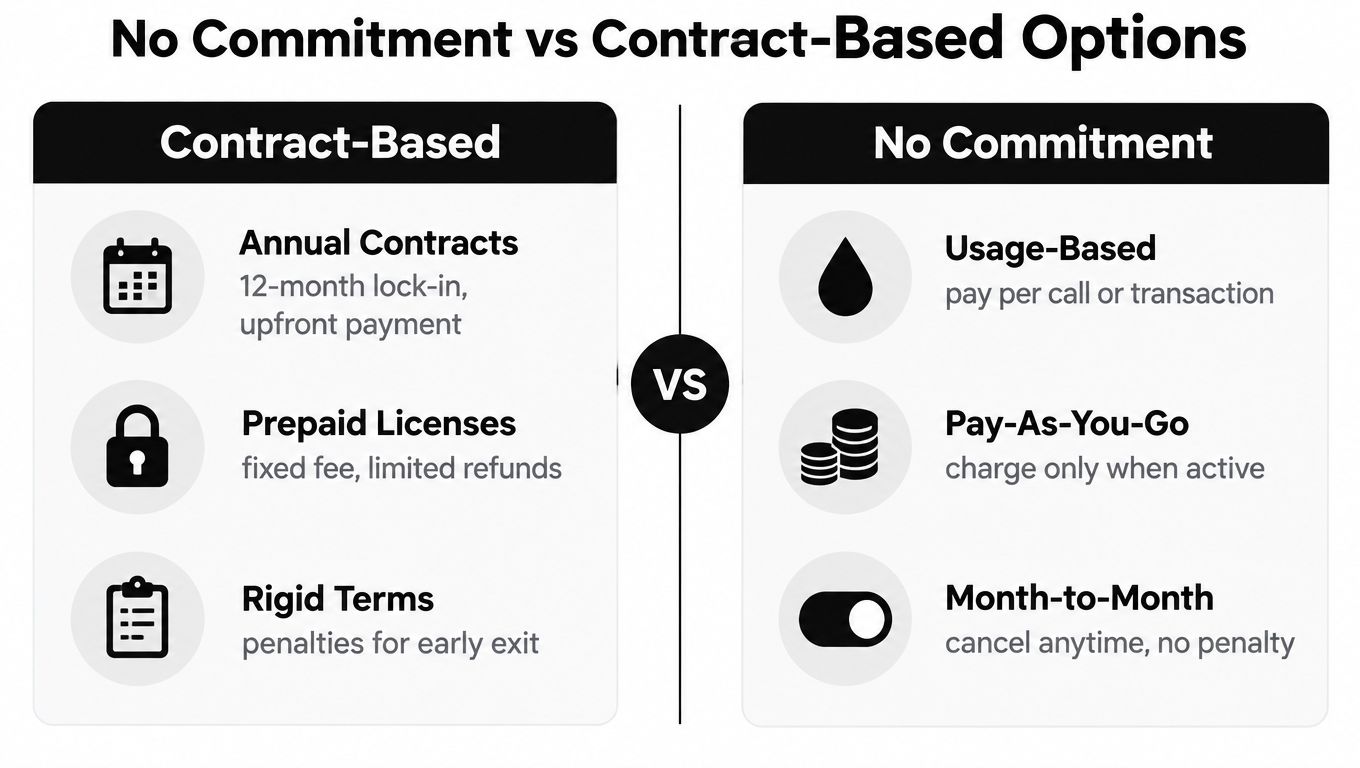
A pricing model decides where uncertainty sits. Contract-based plans ask the customer to commit before actual demand is clear. Usage-based and pay-as-you-go plans keep the initial obligation lower, then charge as activity occurs. Neither model wins in every situation. The choice depends on demand predictability, required capacity, cash flow, and the cost of unused access.
An annual contract provides access for a defined period in exchange for scheduled payment or a promise to pay. A prepaid license follows the same logic, with the buyer purchasing access or capacity in advance. These structures can work well for stable teams that know their requirements and need predictable budgeting. They create more exposure when adoption is uncertain or the business is still testing its workflow.
Where the financial exposure sits
The practical question is: does the customer pay for access that might be used, or for consumption that has already happened?
| Model | Customer pays for | Main advantage | Main risk |
|---|---|---|---|
| Annual contract | A defined access period | Budget predictability | Paying during low usage |
| Prepaid license | Access or capacity purchased in advance | Immediate availability | Limited recovery if needs change |
| Usage-based billing | Measured activity | Cost follows consumption | Less predictable invoices |
| Pay-as-you-go | Active use as it occurs | Low initial commitment | Higher unit cost in some cases |
| Month-to-month | Recurring access for a short cycle | Easy reassessment | More frequent renewal decisions |
Contract pricing is reasonable when guaranteed access matters and the provider must reserve resources. It may also produce a lower effective rate for sustained use. Buyers should review minimum spend requirements, early termination rules, renewal timing, taxes, and charges for unused seats or capacity. Those details determine whether the advertised rate matches the commitment.
No-commitment pricing lowers the cost of choosing incorrectly. A customer can begin with a smaller footprint, observe actual usage, and expand once the workflow proves itself. Microsoft describes the Power Platform pay-as-you-go plan as a way to build and share apps without a license commitment or upfront purchasing. It provides a concrete example of how a major platform turns flexibility into a billing option.
The retention benefit is practical. Buyers gain control when business volume changes, while providers must earn continued payment through useful service rather than an exit barrier. Flexibility therefore becomes a retention asset, not only a sales message. It can reduce the frustration caused by paying for capacity that no longer matches the customer's situation.
Flexibility isn't the same as unlimited access
A flexible plan still includes boundaries. It may charge per transaction, limit included usage, pause access after a failed payment, or apply different rates as consumption rises. “Cancel anytime” does not explain how metering, payment failure, or renewal really works.
Clear pricing pages show both the freedom and the trade-off. They specify what triggers a charge, how usage is measured, whether unused allowances roll over, and when a downgrade takes effect. Buyers comparing limited and unlimited plans should ask whether unlimited access solves a genuine workload problem or makes a higher recurring fee feel safer.
A sound comparison goes beyond the headline price. Estimate likely usage, identify idle capacity, and decide how much invoice variation the business can absorb. No commitment shifts risk toward the provider, but it doesn't remove risk from the transaction. It makes that risk easier to see and control.
How Commitment Length Affects Churn and Retention
Flexibility matters because customers often reassess a subscription before they reassess the product itself. A price increase, a quieter business period, or a competing offer can make cancellation feel necessary. The longer a customer has stayed and built the service into daily routines, the more reasons they may have to remain, but early-stage subscribers remain sensitive to changes in price and perceived value.
A 2025 streaming study reported by Broadband TV News found that 48% of consumers would consider cancelling after a 20% price increase, while almost one in five would consider cancelling after a 10% increase. The same report found that the average expected discount for committing to a one-year plan was 22%, and 41% of respondents used superbundles.
Those figures reveal a practical tension. Consumers may accept a longer commitment when the saving feels meaningful, but the commitment doesn't eliminate sensitivity to future price changes. A discount can win the initial sale while a later increase tests whether the customer still believes the service is worth the constraint.
Retention is built after the first renewal
The same study showed a strong relationship between tenure and cancellation intent. 33% of respondents would still consider cancelling after one year of subscription tenure, compared with 8% after four years, according to the Broadband TV News report. That doesn't prove that longer contracts create loyalty. It shows that customers who remain for longer may become less inclined to leave as habits, stored data, integrations, and trust accumulate.
Providers should treat the early period as a conversion-to-confidence phase. A customer who understands the product, sees useful outcomes, and can adjust the plan without conflict has a reason to continue. A customer who feels trapped may remain temporarily while searching for an exit.
Practical retention work includes:
- Early value checks: Ask whether the customer has completed the first meaningful task, not merely whether they logged in.
- Usage-aware communication: Explain unused features only when they address a visible need, rather than sending generic product tours.
- Clear price notices: Give customers time to evaluate a change and explain what their current plan will become.
- Low-friction account management: Make upgrades, downgrades, pauses, and cancellation understandable without a support exchange.
A flexible account experience also helps client-facing teams. When an account manager can see the customer's plan, usage, and renewal terms in one place, conversations become more useful and less defensive. A practical client account management workflow can support that transparency without treating every cancellation request as a failed sale.
Why no commitment can support loyalty
Some providers worry that removing a contract will make churn immediate. That risk exists, especially when the product has weak onboarding or inconsistent value. Yet a customer who stays because leaving is difficult isn't necessarily retained in a healthy way. They may reduce usage, complain publicly, delay payment, or cancel as soon as the barrier falls.
No-commitment pricing creates a stricter test. The service must earn each renewal through usefulness, reliability, and a fair billing experience. That pressure can improve the product when the provider watches cancellation reasons, identifies the first point of disengagement, and fixes recurring sources of frustration.
Customers don't need to promise they'll stay forever. They need enough confidence that staying this billing cycle makes sense.
The commercial lesson is not that every plan should be monthly or usage-based. It is that commitment length should match how predictable the customer's need really is. A stable enterprise workload may justify a longer agreement. An evolving creator workflow may benefit from a short cycle until usage becomes clear.
The Rise of Pay-As-You-Go in Major Platforms
A team may want to test an internal workflow, build a prototype, or support seasonal demand without turning an uncertain project into a fixed expense. Pay-as-you-go billing addresses that need by letting customers activate services before they accept a large license commitment. Major software platforms now use this model beyond small experiments and niche tools, making flexibility part of the adoption path.
Microsoft's Power Platform offers a clear example. Its pay-as-you-go approach lets customers begin building and sharing apps without an upfront license purchase, while billing follows actual usage. Microsoft also states that the Copilot Studio pay-as-you-go meter was updated to require no upfront license commitment starting December 1, 2024, as documented in its pay-as-you-go overview.
The design changes the buyer's financial decision. A team does not have to forecast future adoption with precision before it starts. It can connect spending to an active use case, observe whether the service earns continued use, and consider a more committed arrangement once demand becomes clearer. Flexibility therefore supports retention through demonstrated value, rather than relying only on the difficulty of leaving.
Usage billing changes the adoption path
Contract pricing usually asks a team to choose a plan, approve spending, provision access, and then discover whether employees adopt the product. Pay-as-you-go reverses that order. A smaller group can begin with a defined use case, review consumption, and expand after the value is visible.
This approach fits several operating situations:
- Prototype work: Teams can test whether an idea merits wider investment before requesting a larger commitment.
- Variable workloads: Businesses can handle quiet and busy periods without carrying the same fixed capacity throughout.
- Department-led adoption: A small group can validate a tool before seeking broader procurement approval.
- Usage-linked budgets: Managers can relate spending to activity instead of paying for access that remains dormant.
A flexible meter does not remove the need for financial discipline. Finance teams still need alerts, spending limits, usage reports, and approval rules. Without those controls, usage billing can replace one source of friction with another: an unexpected bill. Clear thresholds and visible consumption data give the buyer control while preserving the option to scale.
Pricing theory supports staged commitment
Academic pricing research provides a useful way to examine this shift. One framework describes subscription services that combine activation fees, subscription fees, and cancellation fees, with those charges changing as the customer base develops. In that model, cancellation fees are higher early in the service lifecycle and decline as the offering matures, while subscription fees remain low until a stronger subscriber base is established.
The wider lesson is that pricing can change with customer adoption. A new product may need a low-friction entry point while buyers are still evaluating the category. A mature service may support more predictable recurring plans because customers understand its value and the provider has clearer operating costs.
That logic does not support punitive exit fees. Providers should separate the genuine cost of activation from an attempt to discourage cancellation. If onboarding creates a measurable service expense, the pricing page should explain it plainly. If a fee exists only to prevent departure, it weakens trust and may cause the customer to avoid the product altogether.
Pay-as-you-go works when metering is understandable, limits are visible, and customers can move from flexible usage to committed plans without being forced into either one. The strongest systems provide a progression that helps buyers gain confidence before they accept a longer financial obligation.
Implementing Flexible Billing for Creators and SaaS
A small software business doesn't need a complicated pricing architecture to offer flexibility. It needs a clear relationship between customer value, measurable usage, and the provider's costs. Start with the job customers hire the product to do, then decide which part of that job can be included in a recurring tier and which part should vary with consumption.
Creators and small SaaS teams should begin with a simple choice: a short recurring plan for predictable access, a usage-based option for irregular activity, or both. The flexible option should have a visible boundary. Customers need to know what they receive, what counts as usage, and what happens when they reach a limit.

Build the plan around customer decisions
A useful structure might include an entry tier for evaluation, a standard tier for regular work, and a flexible route for customers whose usage changes. The names matter less than the decision each tier supports.
- Define the included outcome. “Manage one workflow” is clearer than a vague promise of access to every feature.
- Choose one primary meter. Use posts, transactions, seats, storage, or another measure customers can understand. Avoid combining several meters unless the product requires it.
- Set a safe starting point. The first tier should let a customer complete a meaningful task without immediately confronting a paywall.
- Offer control before the limit. Send usage notifications and provide a clear upgrade path before an unexpected overage occurs.
- Make cancellation reversible where possible. Preserve work and explain the access end date so cancellation doesn't feel like destruction.
Trial design deserves separate attention. A 2026 subscription benchmark cited by SleekPost reported that opt-in free trials without a credit card converted 18.2% of signups into paid customers, while opt-out trials requiring a credit card converted 31.4% in the 2026 dataset and 48.8% in the 2025 dataset. Across 200 products, the median free-to-paid conversion was 8% in 2026, according to the subscription benchmark cited in the brief.
Those results don't establish that requiring a card is always the right choice. They show the trade-off between conversion and commitment. A card-free trial may attract more cautious evaluators, while a card-required trial can produce stronger initial payment intent but also creates a higher risk of unwanted renewal if the cancellation process isn't prominent.
Validate before you promise
Founders should test pricing with real buying behavior, not only interviews. A customer may say a flexible tier sounds appealing but choose an annual plan once a discount appears. Another may prefer a monthly option because their revenue is seasonal. Track which plan customers choose, where they abandon checkout, and why they cancel.
For a practical approach to testing demand and pricing assumptions, these traction-based pricing tips provide useful context. The important discipline is to change one element at a time. If the price, trial length, included usage, and checkout copy all change together, the resulting data won't tell you what influenced the decision.
A clean billing dashboard is part of the product. It should show the active plan, next billing date, current usage, invoices, and cancellation controls in ordinary language. Customers should be able to review flexible pricing options without hunting through support articles.
Design principle: A cancellation button isn't a leak in the funnel. It's evidence that the provider trusts the product to earn the next renewal.
Flexible billing protects margins when the provider models costs transparently. Set usage alerts, reserve expensive support for plans that justify it, and avoid promising unlimited consumption when a small number of heavy users could overwhelm delivery costs. The goal isn't to remove every boundary. It's to make every boundary understandable before the customer pays.
When No Commitment Pricing Is Actually More Expensive
No-commitment pricing answers the fear of being trapped, but it doesn't guarantee the lowest total cost. Short billing cycles can carry a higher effective price, and repeated renewals can exceed the cost of a longer plan. Buyers should compare the total expected spend over the period they realistically expect to use the service, not just the amount shown at checkout.
Many customers optimize for a smaller initial obligation, which is why recent pricing commentary cited by YallaTech reports that weekly subscriptions capture roughly 47% of total revenue in some app categories. That figure suggests that buyers may value lower upfront commitment even when a shorter cycle isn't the cheapest route over time.
The premium can be reasonable. A creator with unpredictable income may prefer a higher short-term rate to avoid paying through a quiet season. A startup still testing its workflow may pay more for the ability to leave quickly. Flexibility has economic value when it prevents a customer from carrying unused access or making a commitment based on assumptions that may soon change.
Calculate the cost beyond the headline rate
Before selecting a flexible plan, check four things:
- Renewal frequency: A weekly or monthly charge can look manageable while adding up to more than an annual alternative.
- Trial rollover: Confirm whether the trial ends automatically or becomes a paid subscription unless the user cancels.
- Cancellation timing: Find out whether access ends immediately, at the end of the billing period, or after a separate notice window.
- Extra charges: Review taxes, fees, overages, storage, additional seats, and paid upgrades before comparing plans.
The Federal Trade Commission warns that free-trial offers can convert into recurring charges when users miss cancellation windows, a concern also highlighted in the YallaTech pricing commentary. That warning shifts the question from “Can I cancel anytime?” to “Can I see exactly when and how the next charge will happen?”
A transparent plan answers that question at checkout and in the account dashboard. It doesn't hide the renewal date in fine print, make the customer call to stop payment, or treat a cancellation request as an opportunity to create confusion.
Choose flexibility for the right reason
A longer plan is often sensible when usage is stable, the product is firmly embedded in daily work, and the discount compensates for the commitment. A flexible plan is more appropriate when demand is uncertain, cash flow changes, or the customer is still validating the tool.
For creators comparing tools, a cost-conscious social media scheduler should be judged by total workflow value, not only by the smallest advertised subscription. A low price doesn't help if the plan lacks the publishing features, account controls, or reliability needed to replace manual work. Conversely, a higher flexible fee may be wasteful if the service is used only occasionally.
The best buying decision is therefore conditional:
| Situation | More suitable approach |
|---|---|
| Usage changes with projects or seasons | Short-cycle or usage-based billing |
| Demand is stable and well understood | Longer plan after checking exit terms |
| Product is still being evaluated | Trial or low-commitment tier |
| Costs rise sharply with consumption | Metered plan with alerts |
| Renewal would be easy to forget | Plan with clear reminders and controls |
No commitment pricing is not automatically cheaper. It is cheaper when the value of control exceeds the premium for flexibility. Read the renewal terms, estimate realistic usage, and choose the structure that matches how your work changes.
SleekPost offers creators, marketers, and small businesses a single dashboard for scheduling and publishing content across social platforms, with a 7-day free trial and cancel-anytime subscription model. Visit SleekPost to test a flexible way to manage recurring content without taking on a long-term commitment.