
Most advice about multi channel marketing says to publish everywhere, then repurpose the same post until every platform has seen it. That's distribution, not a strategy. A useful multi channel marketing strategy keeps one campaign promise consistent while rebuilding its delivery for each channel and giving every platform a job the team can measure.
The distinction matters for small teams. A U.S. survey of multichannel retail shoppers found that about 36% combined online and in-store channels while browsing and buying, according to research on multichannel shopping behavior. Customers can move between touchpoints, but they don't need to encounter the same creative everywhere. They need a coherent journey.
Table of Contents
- What Stays Consistent and What Changes by Channel
- Choose Channels by Role, Not by Popularity
- How to Turn One Campaign Idea Into Native Posts
- Schedule, Cap and Fix Sequencing Mistakes
- Measure Channels Without Trusting Platform Numbers
- Optimize the Workflow Each Month
- Launch a Pilot Across Two or Three Channels
What Stays Consistent and What Changes by Channel
A multi channel marketing strategy is one campaign objective delivered through several channels, each with a defined role. It isn't the same post copied everywhere. Repetition, mismatched formats and audience fatigue are common costs of treating every platform as a duplicate distribution slot.
Keep the strategic core stable. Rebuild the execution to fit the channel:
| Element | Keep Consistent | Rebuild Per Channel |
|---|---|---|
| Offer and pricing | Same offer and terms everywhere | Frame the offer in the opening line |
| Proof and positioning | Same testimonials, results and claims | Choose the format, such as a screenshot on X or a case study on LinkedIn |
| Campaign objective | One shared goal for the campaign | Assign a role, such as discovery, trust or conversion |
| Hook and length | Core message stays the same | Adapt the opening and length, from a six-second hook to a 300-word post |
| Visuals and aspect ratio | Brand colours and logo | Use native formats, such as 9:16 vertical video for Reels or 4:5 imagery for a feed |
| Call to action | Same destination page | Choose a link in bio, reply prompt or direct link |
| Posting cadence | Same campaign calendar | Set frequency to fit the platform and team capacity |
Say a brand posts the same 30-second video to LinkedIn, TikTok and email. LinkedIn may need a clear professional takeaway, TikTok needs immediate visual action, and an email needs a reason to click. One asset can supply the raw material, but identical packaging asks each audience to do the adaptation themselves.
If the core changes between channels, the strategy has drifted. If the execution never changes, the content hasn't been adapted.
Choose Channels by Role, Not by Popularity
A channel earns a place when it serves a defined audience role, fits a workflow the team can sustain, and has a measurable business outcome. In MoEngage's 2025 research among B2C retail and ecommerce marketers, email was the most-used channel at 78.8%, followed by social media at 74.3%; mobile websites came in at 60.2%, and mobile apps and desktop websites each at 51.3%, according to MoEngage's omnichannel marketing research.
That's a usage snapshot, not a mandate to be everywhere. Start with two or three channels that match how your audience discovers, evaluates and buys. The SleekPost guide to the media marketing mix can help you think through how those channels fit together.

Use a role table to make the choice concrete. Cadences below are starting recommendations, not rules: reduce them if the team can't produce useful posts at that pace.
| Channel | Audience Role | Typical Format | Cadence | Success Measure |
|---|---|---|---|---|
| Discovery and trust | Reels and carousels | 3–5 per week | Reach, saves and profile visits | |
| Trust and B2B conversion | Text posts and document carousels | 2–3 per week | Clicks and comments from target roles | |
| X | Discovery and conversation | Short posts and threads | Daily | Replies and link clicks |
| YouTube | Depth and search | Long video and Shorts | Weekly | Watch time and subscribers |
| Discovery with long shelf life | Vertical pins | 5–10 per week | Saves and outbound clicks | |
| Retention and conversion | Newsletters and sequences | Weekly | Click-through rate and repeat purchases |
A practical portfolio has three kinds of work: discovery through Reels, TikTok or Pinterest; trust-building through YouTube or LinkedIn; and conversion or retention through email and search. Don't add a platform just because competitors use it. Pause one that fails its assigned role for a full quarter, particularly if keeping it active makes the rest of the calendar harder to manage. For teams coordinating messages across touchpoints, the YipSMS guide to SMS orchestration offers a useful view of how channel timing can be planned as part of a customer journey.
How to Turn One Campaign Idea Into Native Posts
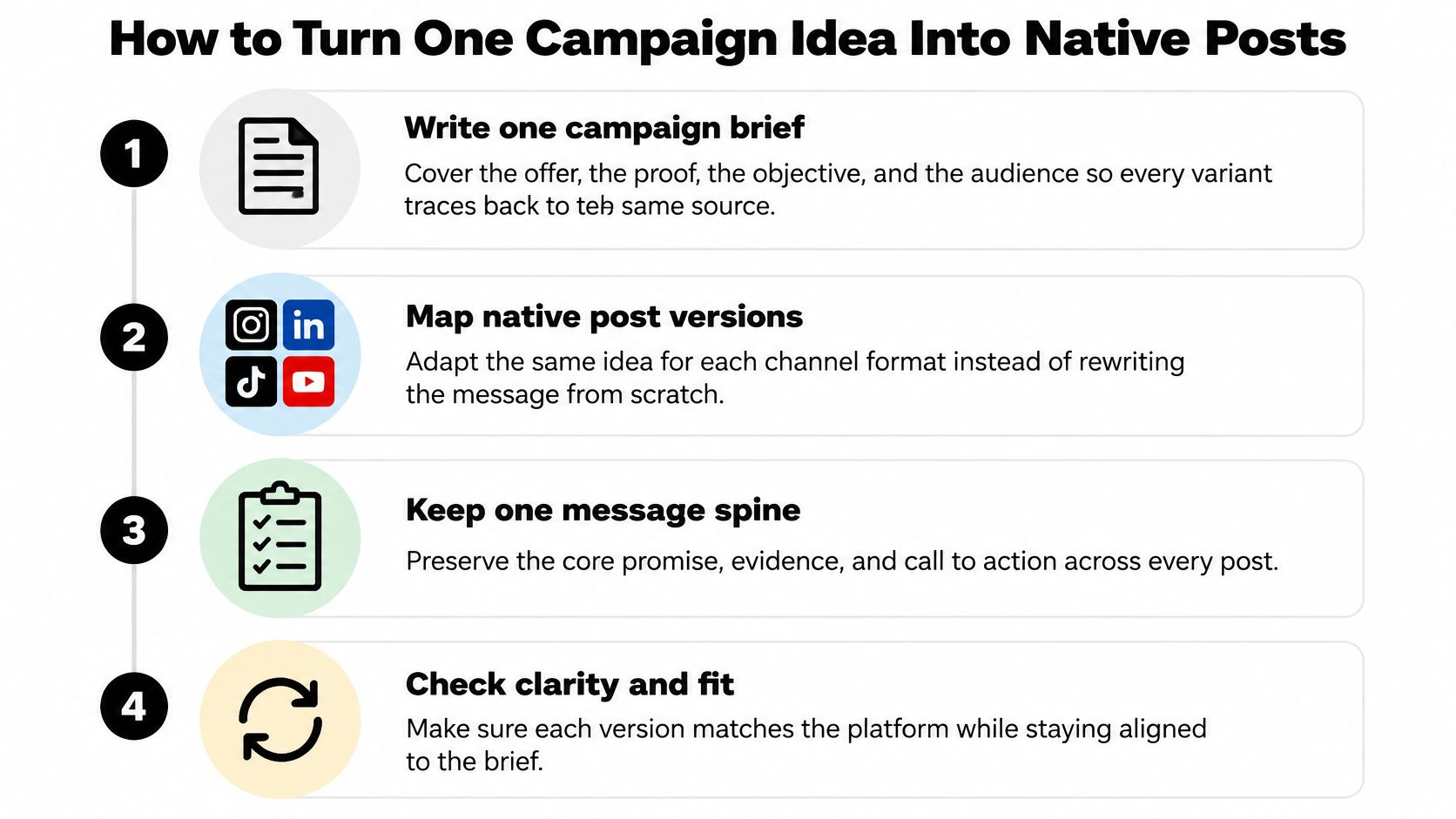
The strategic core stays fixed: offer, proof, audience, objective. Everything downstream can change. A Reel and a LinkedIn post can share the same proof point but should not share the same opening line. The most common failure is writing one master post, then trimming it until every channel gets a thinner version of the same thing. Native work starts with the role each channel plays, then rebuilds the post around that role.
Follow these steps before scheduling:
Write one campaign brief. Record the offer, proof, objective and audience so every version has the same reference point. For a bakery promoting a seasonal box, that means one clear offer, customer feedback as proof and online orders as the shared goal. Treat the brief as a decision record. If a variant cannot trace back to it, cut the variant.
Assign each channel a role. Decide whether the post should spark interest, build confidence or convert an already-interested buyer. The role tells the writer what the post must accomplish, even when the format changes. A channel that needs a long explanation to justify its place in the campaign is usually the one to drop.
Draft a native hook. Try a question or a contrarian claim on X, a specific business result on LinkedIn, and visible action in the first seconds of a Reel or TikTok. A hook should earn attention from a person who has not seen the campaign elsewhere. If the opening only works after someone has read the LinkedIn post, rewrite it.
Adapt the format. Turn a longer demo into a short vertical clip, a carousel and a text post with one takeaway. Give the strongest point a form each platform can carry rather than producing extra content for its own sake. For a repeatable process on matching formats to channels, this guide to content repurposing strategy covers the handoffs from source asset to native post.
Tag every link. Add UTM parameters with a consistent campaign and channel naming convention. That makes it easier to identify which variant brought someone to the landing page. Keep the naming boring. A clean campaign and channel string is easier to audit than a clever one.
Save and label each version. Keep drafts marked by channel, with a short note on how the asset can be reused. A scheduler such as SleekPost can keep per-platform variants in one calendar and publish to chosen networks through their official APIs, removing the manual copy-and-paste step. If creator-led ads are part of the plan, Sup's overview of influencer whitelisting explains how a creator's content can be used in paid social.
Before publishing, ask whether the post would still make sense to a stranger who encounters it in that platform's feed. If it needs context from another channel, rewrite the opening.
Schedule, Cap and Fix Sequencing Mistakes
A campaign shouldn't arrive everywhere as one simultaneous blast. Sequence it so discovery introduces the idea, trust-building content answers objections, and conversion messages reach people where they're ready to act.
For a B2B software launch, a workable schedule might look like this:
| Timing | Channel and Asset | Purpose |
|---|---|---|
| Monday, week one | LinkedIn carousel | Introduce the problem and campaign promise |
| Wednesday | YouTube product demo | Show how the product works |
| Thursday | Short X thread | Surface a useful takeaway and invite discussion |
| Friday | Email to the list | Give subscribers a direct next step |
| Tuesday, week two | Retargeting recap | Re-engage interested visitors with a clear offer |
The spacing gives people more than one way to understand the offer without flooding them with the same message. Use the guide to scheduling a post to build the calendar around actual publishing dates and owners, not an abstract campaign start date.
Three controls prevent a coordinated schedule from becoming overexposure:
- Cap repeated impressions. If someone has seen an offer several times in a day, exclude them from another impression that day. The right cap depends on the channel and campaign; the operational point is to stop unnecessary repetition.
- Suppress converters. Remove customers who have already bought from acquisition ads, then move them into onboarding or retention communications where appropriate. Continuing to sell the same offer to a recent buyer wastes spend and can erode trust.
- Separate evergreen from urgent content. Recurring posts and auto-reposts can keep durable material in circulation. Keep deadline-based offers out of the recurring queue so an expired promotion doesn't resurface.
When frequency climbs, first reduce delivery on channels that aren't doing their assigned job. Then check whether suppression rules are working and whether the sequence gives the audience a useful next step. Review the calendar after the first results arrive, and adjust the order or cadence based on outcomes rather than defending an arbitrary schedule.
Measure Channels Without Trusting Platform Numbers
Platform conversion totals aren't automatically comparable. Each service can use its own attribution window and identity rules, so adding reported conversions together can count the same buyer more than once or credit different touchpoints inconsistently.
Forrester found that only 30% of surveyed firms used advanced, statistics-based approaches to measure marketing and media impact, according to its cross-channel attribution study. Nielsen's 2025 Annual Marketing Report also found that 32% of marketers globally measured media spending together across digital and traditional channels, as reported in Nielsen's report announcement. For most small teams, the practical response isn't elaborate software. It's a consistent measurement routine.
| Method | Question It Answers | Effort | Best Used When |
|---|---|---|---|
| Last-touch attribution | Which channel received the final click? | Low | Weekly checks, never the only basis for budget moves |
| Platform-reported conversions | What does each platform claim credit for? | Low | Comparing creatives inside one platform with the same window |
| Cohort comparison | Do periods or segments with a channel outperform those without it? | Medium | A channel is paused or launched over a clear window |
| Self-reported attribution | Which channels influenced buyers, in their own words? | Low | Small teams without attribution tools |
| Holdout or geo test | Does a channel add conversions that wouldn't happen otherwise? | High | Budget is large enough to withhold spend in one region or audience |
Start by choosing one conversion event, then use a shared campaign naming convention and record cost, impressions, clicks and conversions for each channel. Deduplicate users where possible, document each platform's lookback window, and report on a fixed time period. The guide to tracking performance can help organize the measures you review.
Compare last-touch results with an incrementality check, such as pausing a channel in one region or comparing periods with and without it. A channel with few direct sales may still support branded search, email sign-ups or later conversions. Don't declare a winner from a handful of conversions or a few days of activity; wait until the test has enough evidence to support a useful decision.
Optimize the Workflow Each Month
A multi channel marketing strategy should get more efficient as the team learns. Review the work regularly, but don't turn every fluctuation into a new campaign.
Check outcomes weekly. Compare each channel's results against its assigned measure, then note where it has drifted. A channel intended to build trust shouldn't be judged only by immediate sales.
Review production effort monthly. Track which hooks and formats take the most time, and template the repeatable parts. If a carousel consistently needs a fresh design from scratch, create a reusable layout rather than asking the writer to solve the same production problem each time.
Build a native-hook library. Keep useful openings by channel in the scheduler so writers don't start every draft from a blank page. Treat examples as starting points, not copy to paste blindly.
Assign clear owners. One person should own the campaign brief, with a named owner for each channel. When an offer or claim changes, the brief owner can make sure every variant gets updated.
Apply the stop-doing rule quarterly. Pause channels that have failed their role test for a full quarter, then reassign the effort to channels meeting theirs. A marketing workflow management guide can help teams keep responsibilities and handoffs visible.
Keep the variants, calendar and media in a shared workflow where the whole team can review what's planned and what's already been published. That makes it easier to compare results without rebuilding the picture from scattered exports.
Launch a Pilot Across Two or Three Channels
This month, choose two or three channels that fit your audience and assign each one a distinct role. Write a single campaign brief with one offer, one conversion event and a consistent UTM naming convention.
Run a four-week pilot with a fixed reporting window. Where practical, include a control period or holdout so you can distinguish added value from activity that would have happened anyway. Expand only when the pilot produces a defined outcome, such as more qualified traffic or assisted conversions, and the team can create the next set of native variants without doubling the workload.
SleekPost lets users post to multiple social platforms from one dashboard, customize each post for its platform, and manage drafts, variants, a content calendar and a media library in one place. Keep the pilot in one workflow, then judge it by the role each channel was assigned.
More channels only help when each one has a role and a way to be measured.
Build your pilot around distinct channel roles, then keep the adapted posts and publishing calendar organized in one place. SleekPost lets you customize and schedule content across platforms from a single dashboard, so your team can spend less time copying posts and more time improving the campaign.