The advice to put your business on every social network is a poor starting point. You don't need more accounts to neglect. You need a manageable way to reach potential customers, show them why they should trust you, and give them a clear next step.
If you're figuring out how to promote small business on social media, start with one discovery channel, one trust channel, and one owned conversion path. Build around the hours you can protect, then judge the work by inquiries and sales, not by how busy your content calendar looks.
Table of Contents
- Why Social Promotion Beats Occasional Posts
- Pick a Small Platform Mix That Fits Your Hours
- Run Organic Tests Before You Spend on Ads
- Build a Weekly Content System You Can Repeat
- Measure Business Outcomes Not Vanity Metrics
- Start Your Next Four Weeks of Promotion
Why Social Promotion Beats Occasional Posts
Posting only when you have a sale makes every appearance an ask. Customers see the promotion, but they haven't necessarily seen the work, judgment, or service behind it. Give them useful reasons to pay attention before you need them to buy.
The audience opportunity is substantial. At the beginning of 2025, DataReportal reported approximately 5.24 billion active social media user identities, equivalent to 63.9% of the global population, with growth of 4.1% over the preceding year; its report also cited monthly social network or messaging use among 96.7% of internet users aged 16 and above across 54 major economies, in its Digital 2025 global overview.
Those are user identities, not necessarily unique people, and they aren't your addressable customer list. The practical conclusion is narrower: find where your customers already spend time, rather than assuming your preferred network reaches them.
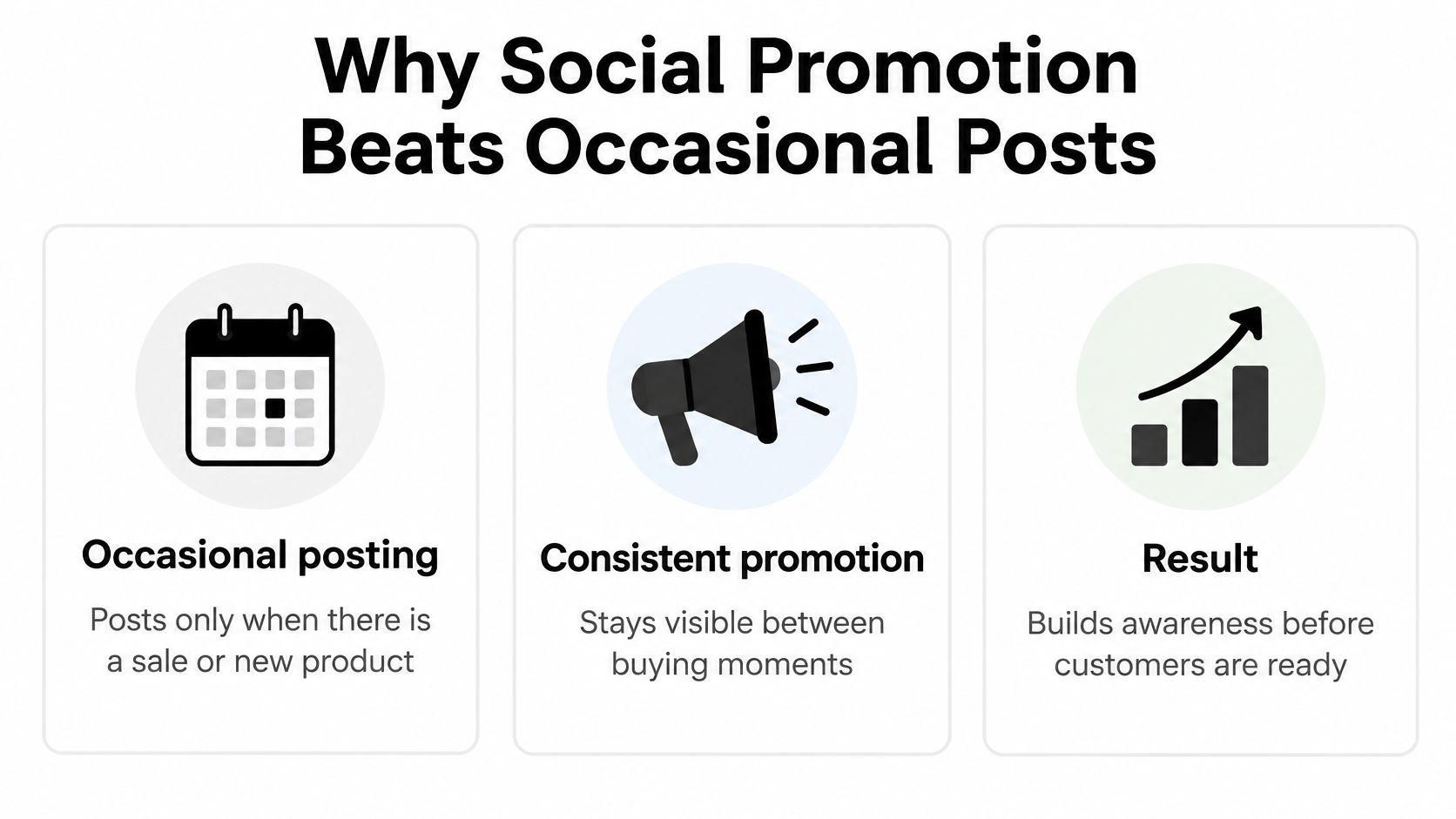
Publish between buying moments
Treat social media as a distribution channel for expertise, not a noticeboard for discounts. A repair business can explain what makes a fault urgent. A retailer can demonstrate how to choose between products. A consultant can unpack a decision that prospective clients find confusing.
These posts give people something to evaluate beyond your price. They also give you a chance to hear the questions and objections that a polished sales announcement might never uncover.
Practical rule: Publish something that helps a customer make a decision, even when that decision isn't to buy today.
Before deciding what to publish, use the Blu Dragonfly LLC resource to set meaningful social media marketing goals. Write your own goal in customer terms, such as generating suitable consultation requests, rather than increasing visibility.
Give consistency a business purpose
Use organic publishing to test explanations, topics, and offers. Reserve paid distribution or partnership activity for messages that earn a meaningful response. Don't pay to spread a confusing proposition further.
Your audience growth strategy should support that customer promise, not distract you with unrelated follower acquisition.
For a time-poor owner, consistency can mean a few useful posts each week, prepared ahead of time. Explain whom you help, show relevant evidence, and provide a reason to reply, book, or buy. Reach matters only when the right people can recognize what your business does for them.
Pick a Small Platform Mix That Fits Your Hours
Choose your workload before choosing your platforms. Count the time available for creating posts, adapting them, answering messages, and checking results. A channel you can publish to but can't maintain isn't a sensible addition.
This is a capacity problem, not a lack of apps. 56% of SMB leaders find social media difficult to prioritize, while 54% struggle to produce enough content for multiple channels, according to eMarketer's coverage of small-business social media challenges.
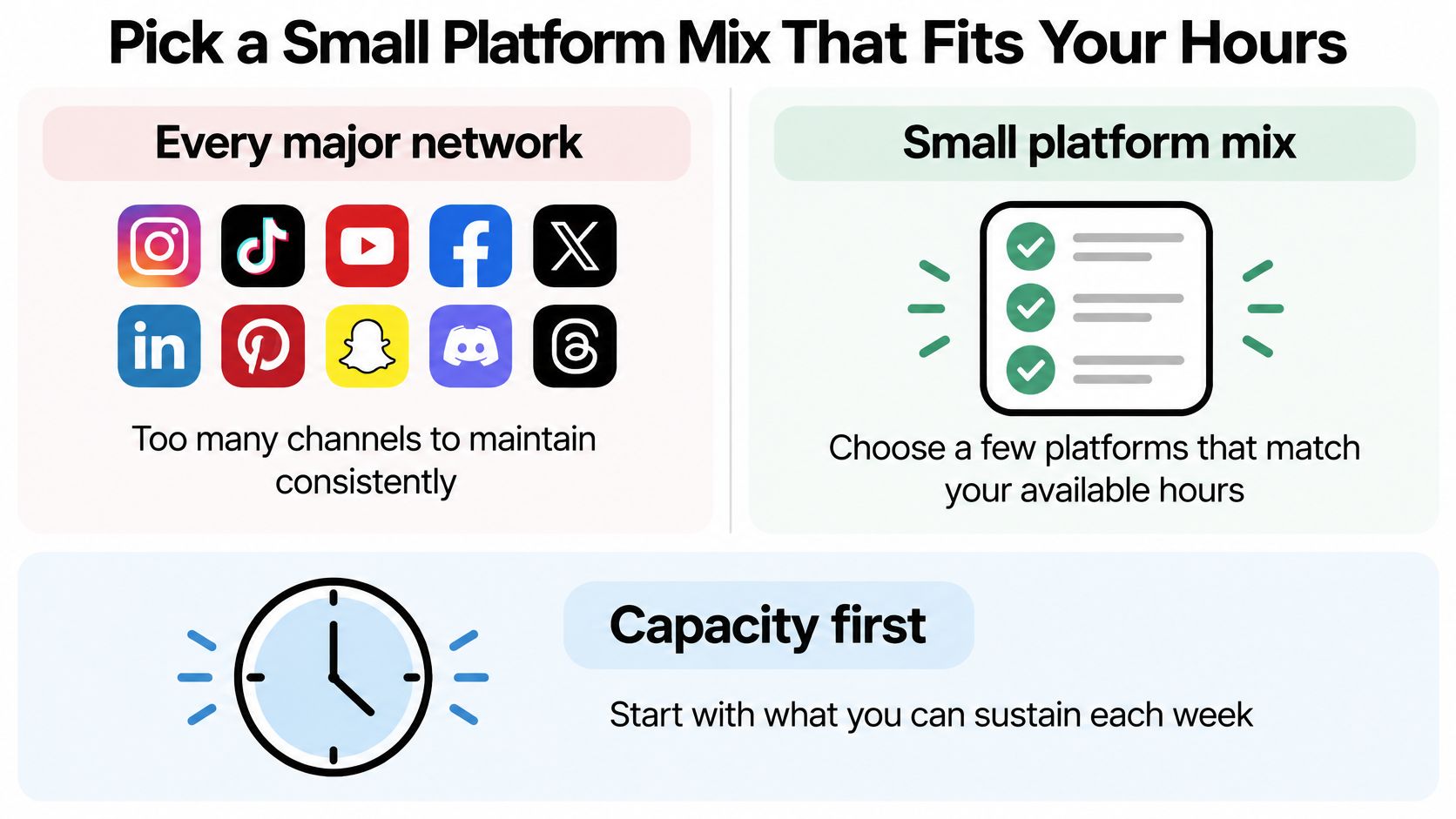
Assign jobs instead of collecting accounts
Your discovery channel introduces the business to potential customers. Your trust channel gives interested people evidence and conversation. Your owned conversion path takes them to a destination you manage, such as your website's booking page, product page, or inquiry form.
A social direct message can start the conversation, but it isn't an owned destination. When appropriate, move that inquiry into your booking process or customer records with permission.
Three-Role Platform Mix
| Role | Job to be done | Common fit | Stop if |
|---|---|---|---|
| Discovery | Put a useful idea in front of unfamiliar prospects | Test Instagram or a short-form video option such as TikTok or YouTube Shorts for demonstrations; consider LinkedIn for professional problems | Attention comes from people who aren't plausible buyers |
| Trust or community | Show evidence and answer questions | Consider Facebook for an existing local community, Instagram for visual proof, or LinkedIn for professional discussion | Maintaining the channel prevents timely customer responses |
| Owned conversion | Turn interest into a recorded business action | Your booking page, product page, landing page, or inquiry form | Visitors can't understand the offer or complete the action |
These are starting hypotheses, not universal rankings. Ask recent customers where they discovered you and where they checked your work before deciding. Their answers are more useful than a platform's popularity in the abstract.
Expand only when the workload earns it
The same network can handle discovery and trust. You don't need separate accounts merely to satisfy a framework. Use your social media marketing mix to cover distinct customer needs with the least duplication.
Repurpose an idea, not an untouched caption. A furniture repair demonstration might become a visual explanation on Instagram and a discussion of replacement decisions on LinkedIn. The underlying expertise stays the same; the opening and context change.
Before launching another channel, write its intended outcome and review date. The RedactAI resource offers a useful prompt to measure what matters in social marketing before adding more activity.
Pause a platform when a properly executed test misses its written business goal and offers no credible supporting value. Don't keep feeding an account just because you've already spent time building it.
Run Organic Tests Before You Spend on Ads
Opening accounts isn't the difficult part. Giving followers a reason to become customers is.
In an early-2024 survey of 620 Goldman Sachs 10,000 Small Businesses participants, 91% used social media, 80% used between two and five platforms, and 65% posted at least weekly, while 21% identified converting followers into customers as their biggest social media challenge, according to the Goldman Sachs small-business social media survey.
Use that distinction to guide your tests. You're not trying to prove that you can publish. You're trying to discover which message helps a suitable customer move forward.
Test content with a clear job
Start with different reasons for someone to engage:
- Show proof. Explain a completed job, the customer's problem, and your approach. Use customer material only with permission, and don't imply results you can't substantiate.
- Answer a real question. Address an issue you've heard during sales conversations. Invite readers to describe their situation rather than asking for empty agreement.
- Demonstrate the offer. Record a simple clip showing what the product does or what the service includes. Clear sound and a useful explanation matter more than elaborate editing.
- Ask for action. State who the offer suits, what happens next, and where to inquire or buy.
For a feed post, lead with the customer's problem and explain the evidence. In a story or short video, demonstrate the problem visually and keep the next step easy to follow. In a professional update, emphasize the business decision behind the offer.
Keep the offer consistent enough to compare responses. If you change the audience, promise, creative, and destination together, you won't know which change helped.
Spend to extend a useful message
Comments, saves, and profile visits can justify further investigation. Qualified inquiries are stronger evidence of commercial relevance. Read replies carefully: a pricing question suggests a different next step from a compliment by someone outside your service area.
Consider a hypothetical local cleaning business. If a post explaining an end-of-tenancy clean attracts relevant availability questions, test a capped paid promotion to the appropriate service area with a working quote page. Don't spend on a generic logo post merely because it looks polished.
For a hypothetical product business, promote a demonstration that prompts useful questions about fit or use. Send people to the matching product page, not an unrelated homepage. Set the spending ceiling and stop condition before launching.
Don't pay to amplify a message you haven't made clear enough for an interested customer to act on.
Maintain a publishing cadence you can support, and use your account's response patterns to investigate the best time to post on social media. Timing is a variable to test, not a rescue plan for a weak offer.
Build a Weekly Content System You Can Repeat
A folder of unfinished captions isn't a content system. Your system should produce a visible calendar, approved assets, and posts that don't depend on you remembering to publish during a busy afternoon.
Separate production from daily operations. Capture material while you're working, then draft and schedule during a protected planning session. Keep customer replies on a separate task list so scheduling doesn't become an excuse to stop listening.
Collect once, then adapt deliberately
Start with customer questions, upcoming availability, approved work photos, product demonstrations, and offers you're ready to fulfill. Store them together with notes about permissions and any details that need checking.
Build your batch around that material:
- Choose the customer decision. Decide what each post helps someone understand, compare, or do.
- Draft the core explanation. Write the useful idea before worrying about platform-specific wording.
- Adapt the presentation. Select the image, clip, carousel, or text format that suits each chosen channel.
- Check the destination. Open every booking or product link and confirm that it matches the post.
- Queue and review. Preview the calendar, check dates, and remove accidental repetition.
A photo sequence can become a carousel explaining a process. The same source material can support a narrated video or a text update about the decision behind the work. Don't force every idea into every format; repurposing should reduce unnecessary production, not create another quota.
Use a documented content planning process so another person could understand what's ready, what's scheduled, and what still needs approval.
Choose tools for the work you actually have
Manual publishing is reasonable when your workload is light and you can reliably be present. A scheduler becomes useful when you're repeatedly switching accounts, copying assets, or missing planned posts.
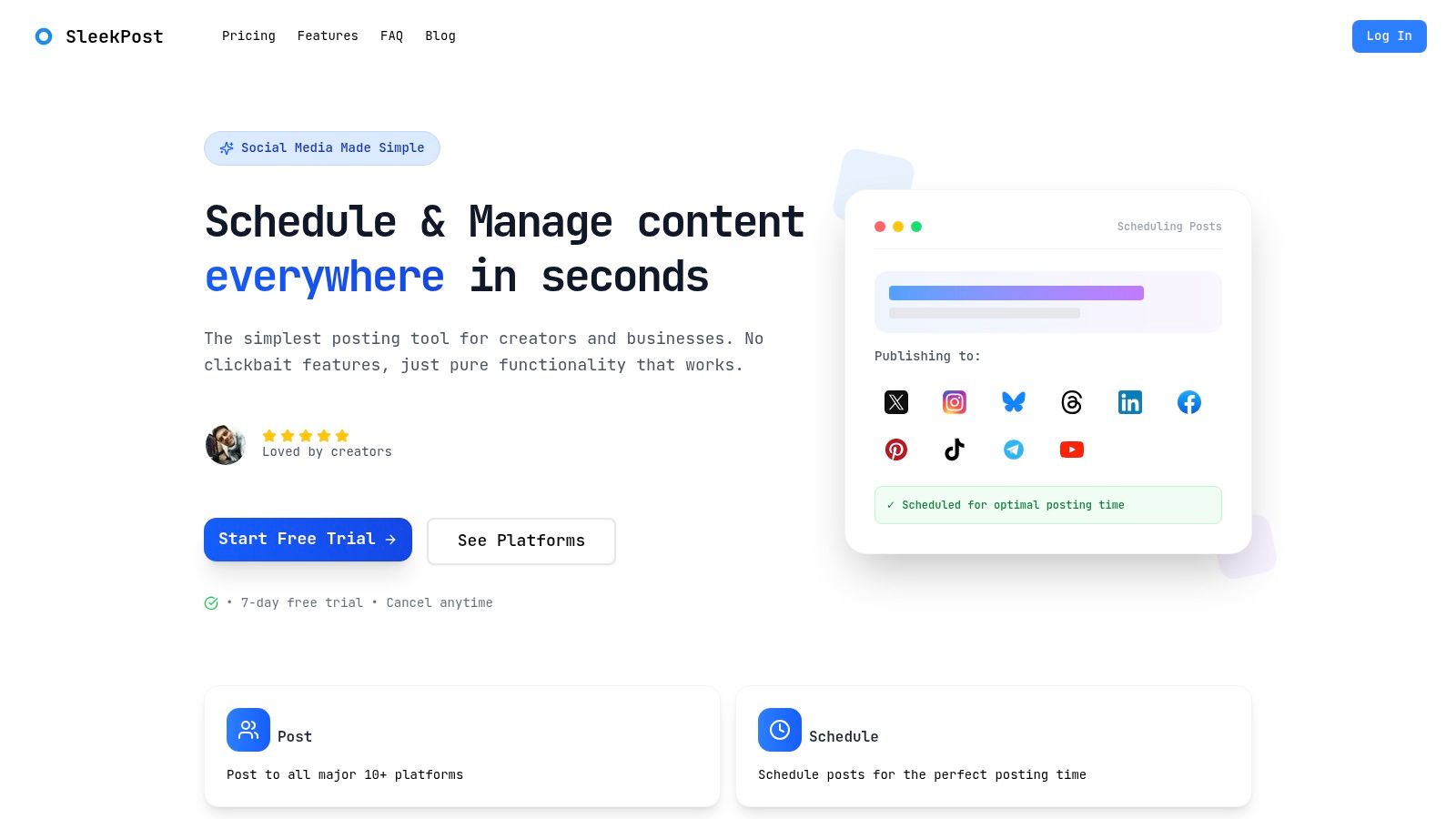
SleekPost is one option for managing scheduling and publishing from a single dashboard, with platform-specific copy and media, queues, recurring posts, a media library, and AI-assisted drafts. Its supported formats include carousels, videos, reels, and text updates; use those capabilities for your chosen channels rather than treating platform coverage as a reason to expand.
AI-generated copy still needs your review. Check product details, customer promises, tone, and calls to action before approving anything. A fluent draft isn't evidence that its claims are correct.
Scheduling boundary: Automate publication, not your judgment about whether a post is still appropriate.
Reserve recurring posts for evergreen material. Review availability announcements, prices, seasonal advice, and offers before they repeat. Keep a way to pause the queue when circumstances change.
The finished output should be a calendar you can inspect, not a promise that you'll find time later.
Measure Business Outcomes Not Vanity Metrics
A popular post can still be commercially irrelevant. A modest-looking post can be useful if it brings the right customer into a sales conversation. Keep engagement metrics for diagnosis, but don't let them decide your budget alone.
In a 2025 survey, 55% cited customer acquisition as their top concern; a separate global survey of nearly 6,000 small businesses found that 64% relied on social media marketing as their primary promotion channel, as presented in the Constant Contact Small Business Now report.
That makes a practical scorecard more useful than another dashboard full of impressions. Start with a spreadsheet and records your team can maintain accurately.
Record the path from post to purchase
Give each promotional post a primary call to action. When an offer needs distinct tracking, use a campaign-specific destination, tagged link, or coupon code that you can connect to the offer.
| Record | What to capture | Why it helps |
|---|---|---|
| Intended action | Inquiry, booking, sign-up, or purchase | Defines what success means |
| Origin | Platform, post, campaign, or customer-reported discovery | Connects activity to interest |
| Lead quality | Fit, location, need, and readiness | Separates suitable prospects from irrelevant volume |
| Outcome | Booked, purchased, pending, or unsuitable | Shows what happened after engagement |
| Decision time | First known social contact and purchase or booking date | Prevents premature judgments |
| Repeat business | Whether the customer returns | Adds context beyond the initial transaction |
Label inbound messages consistently. If someone asks about a service, record the topic and source before the conversation disappears into an inbox. Don't collect unnecessary personal details just to make the spreadsheet look complete.
Count assistance without claiming certainty
Last-click attribution records the final identifiable route to a conversion. An assisted view also records earlier social contact, such as a demonstration that answered a concern before the customer searched for your business.
Ask customers how they found you and what helped them decide. Keep those answers separate from directly tracked conversions, and avoid counting the same sale twice. Treat self-reported influence as useful context, not perfect proof.
Each Friday, use a brief review to record new inquiries, qualified leads, completed outcomes, unresolved conversations, and time spent. A social media ROI calculator can help organize the financial side, provided you include production and response time rather than advertising costs alone.
Run a four-week test with a defined audience, offer, and measurable action. If results remain unclear, change a single variable and test again. Keep a channel that produces suitable customers, fix a broken step, and pause activity that misses its goal without credible assisted value.
Start Your Next Four Weeks of Promotion
Turn the plan into calendar appointments before opening another social app. Put a start date and review date beside each stage, then assign responsibility for publishing, replies, and recording outcomes. If that's all you, protect the work as deliberately as you protect customer appointments.
Week one establishes the boundaries
Write whom you serve, the problem you solve, and the action you want a prospective customer to take. Lock your channel choices and leave extra networks out of the test.
Prepare the assets before drafting:
- Work evidence. Gather clear photos, demonstration clips, and approved customer material.
- A working destination. Check your booking form, product page, or inquiry page on a phone.
- Customer language. Collect recurring questions and objections from actual conversations.
- Offer details. Confirm eligibility, availability, terms, and who will respond.
Your deliverable is a ready-to-use brief for the business, not a list of content ideas without an offer.
Week two produces the calendar
Batch the proof, advice, demonstration, and promotional posts. Adapt them for the selected accounts, check the previews, and queue the approved versions.
Assign someone to monitor responses after publication. A scheduled post with an unanswered buying question is unfinished marketing work.
Week three makes amplification conditional
Review the organic responses before spending or approaching a partner. If a message attracted suitable interest, consider a capped paid test or a relevant collaboration.
If it didn't, improve the message or destination first. You don't owe the calendar an advertising campaign just because you've reached this stage.
Week four ends with a decision
Review the scorecard against the goal you wrote at the start. Keep posts and channels that generated useful inquiries or sales, revise those that attracted attention without action, and pause those that didn't justify the workload.
Don't respond to disappointing results by adding more accounts. Identify the weak step: unsuitable audience, unclear promise, insufficient evidence, difficult booking process, or slow follow-up.
Your immediate next step is operational. Open your scheduler, connect only the accounts you've selected, and schedule the first batch before returning to daily work. Leave the review appointment on your calendar so publishing doesn't become an activity nobody evaluates.
Visit SleekPost to prepare platform-specific posts and manage your selected accounts from a single dashboard. Use the free trial to queue your first week of promotion, then review the inquiries and sales before committing to a larger workload.