You publish consistently, watch the reach fluctuate, and still can't explain why the audience isn't growing at the pace you expected. One post attracts attention, the next disappears, and the team responds by producing more content without checking whether the right people are seeing it, returning to it, or taking the next step.
An effective audience growth strategy treats growth as a connected system. Goals determine the audience you need, audience insight shapes your content pillars, pillars guide distribution, and measurement shows what deserves more effort. Social reach matters, but sustainable growth also requires a path from discovery to subscription and repeat engagement.
Table of Contents
- Setting Goals and Defining Your Ideal Audience
- Building Content Pillars and a Repurposing Workflow
- Analyzing Platform-Specific Growth Opportunities
- Scheduling, Automation, and Scaling with SleekPost
- Community Tactics and Measuring Retention
- Your 90-Day Implementation Timeline
Setting Goals and Defining Your Ideal Audience
Passive posting usually starts with a vague objective: get more followers, increase visibility, or become more active online. Those goals sound reasonable, but they don't tell a team what to publish, where to distribute it, or how to decide whether a result is useful. Before writing another caption, define the business outcome and the audience behavior that should support it.
Start with a measurable baseline
Use the previous 90 days as your starting point. Record your current follower growth rate, social-attributed sessions, profile visits, email subscriptions, qualified inquiries, or another metric that connects audience activity to a business outcome. Choose one primary growth metric, then keep supporting metrics available for diagnosis.
A sensible target is a 15-20% improvement above your current baseline, as recommended in the DataReportal social media user dataset. The target isn't a promise of performance. It gives the team a clear improvement threshold while leaving room to investigate whether more attention is producing meaningful action.
Use secondary metrics to explain the result:
- Reach and impressions: Did distribution expand?
- Engagement quality: Did people save, share, reply, or ask relevant questions?
- Traffic: Did social activity send visitors to the intended page?
- Conversion behavior: Did those visitors subscribe, enquire, or buy?
- Repeat activity: Did the same audience return?
A follower increase without better reach, clicks, or conversions can hide weak content-market fit. Don't let a dashboard turn a convenient number into the definition of success.
Build an audience profile that changes your content
An Ideal Customer Profile should describe more than age, job title, location, or company size. Those details can help with targeting, but they rarely explain why someone stops scrolling and decides to follow.
Write down the audience's recurring problems, current alternatives, objections, desired outcomes, language, and information habits. Note what they already believe and what would make them reconsider it. Review comments, customer calls, support tickets, search queries, and sales objections. The objective is to capture context and motivation, not produce a decorative persona document.
If you need a structured starting point, this guide on how to identify your target audience offers a useful way to turn broad demographics into actionable audience insight. Then map each audience segment to a clear promise, such as helping a small marketing team plan content without adding another complex workflow.
Your distribution choices should reflect that profile. An omnichannel content strategy only works when each channel has a defined role, rather than becoming a list of accounts that receive identical posts.
Practical rule: If you can't explain who a post is for and what action it should prompt, the post isn't ready for production.
Building Content Pillars and a Repurposing Workflow
Once the audience is clear, content production needs boundaries. Without them, teams alternate between whatever is trending, whatever was requested most recently, and whatever can be published fastest. That creates activity without a recognizable reason to follow.
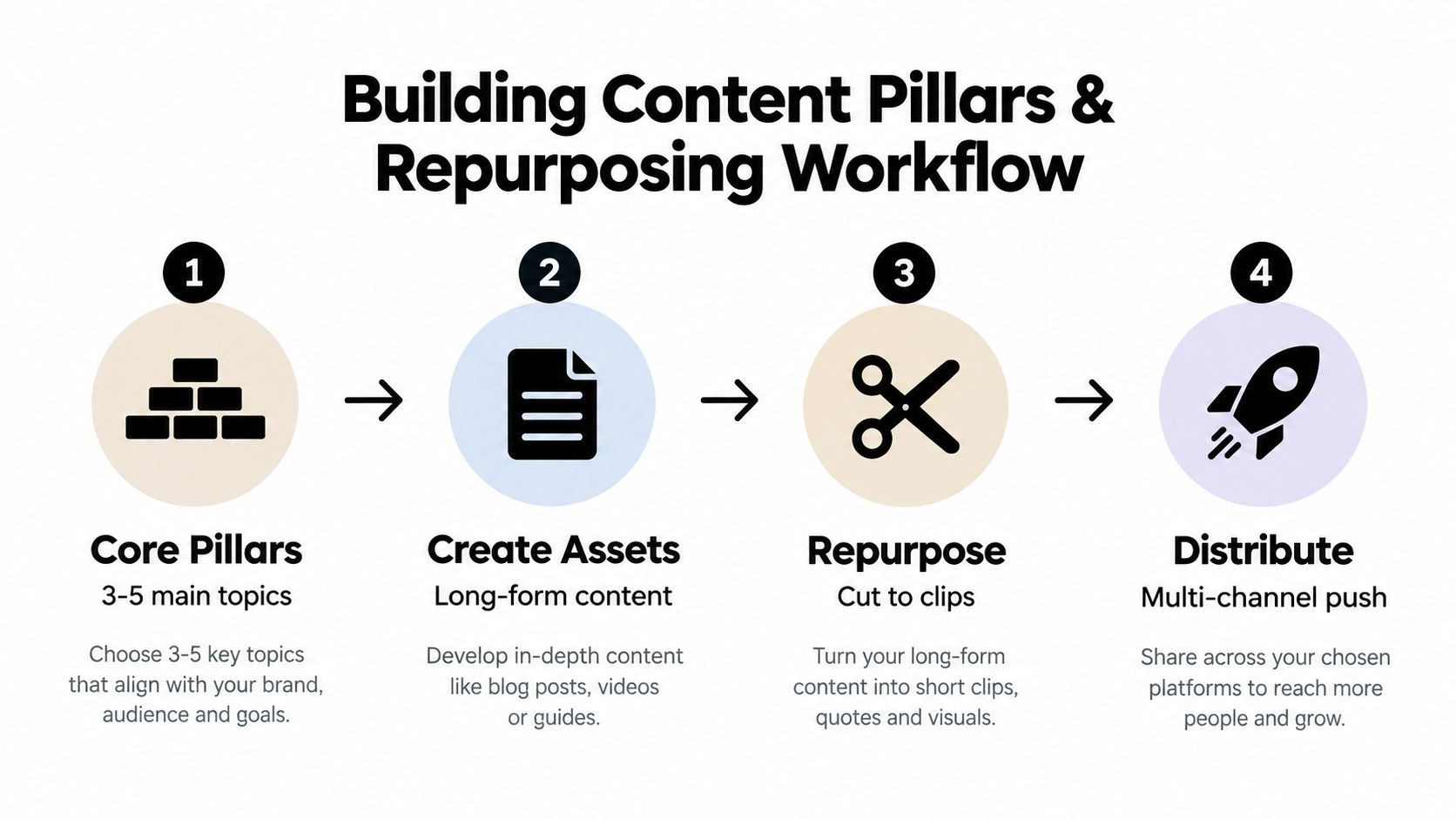
Choose three to five content pillars that sit at the intersection of your expertise and your audience's recurring needs. A software company might use workflow education, customer problems, product use cases, industry interpretation, and founder perspective. A consultant might choose practical tutorials, buying guidance, client questions, professional opinions, and behind-the-scenes decisions.
Turn pillars into repeatable ideas
Each pillar should generate several formats, not one permanent post type. Start with a substantial source asset, such as a webinar, interview, detailed article, research summary, or long-form video. Pull out the strongest explanation, the most common objection, one useful example, and one action the audience can take.
Then assign each extract a job:
- Discovery asset: A short video, visual hook, or concise opinion designed to reach people who don't know you.
- Teaching asset: A carousel, article, or thread that makes one difficult idea easier to apply.
- Trust asset: A process breakdown, response to a real question, or transparent explanation of a decision.
- Conversion asset: A clear invitation to subscribe, request information, start a trial, or explore a relevant offer.
The work isn't finished when the source asset is published. Create a brief for each platform that changes the opening, pacing, dimensions, caption, call to action, and metadata. Repurposing means adapting the idea to audience behavior. It doesn't mean copying the same caption into every feed.
Create a production chain
A practical workflow separates editorial judgment from repetitive formatting. One person can choose the angle and approve the message, while templates and tools handle resizing, transcription, clipping, scheduling, and version management. An AI tool for viral clips can help identify short-form extracts from longer video, but a human still needs to reject clips that lack context or misrepresent the original point.
Keep a content inventory with the pillar, audience problem, source asset, platform versions, publication status, owner, and next review date. That prevents a common failure mode: producing many assets from one idea while overlooking whether any of them earned a meaningful response.
A content repurposing strategy should also include a feedback step. Mark which hooks earned attention, which explanations generated questions, and which calls to action produced useful traffic. Feed those observations back into the next source asset.
The efficiency gain comes from making one strong idea travel further, not from lowering the standard for every derivative asset.
Analyzing Platform-Specific Growth Opportunities
A portfolio approach beats single-platform dependence because platforms reward different formats, audiences, and behaviors. Global social usage is already enormous and continues to expand. One 2026 benchmark reports about 5.24 billion users, 64.8% penetration, and roughly 227 million new users year over year, while another benchmark counts 5.79 billion active social media identities, up 5.3% from 2025. These figures come from the 2026 social media statistics overview, and they point to a crowded opportunity, not an excuse to publish everywhere.
A platform's total size doesn't tell you whether it suits your audience or creative resources. Benchmark growth can help prioritize testing, but it shouldn't replace audience evidence.
Compare growth without confusing it with fit
| Platform | YoY Growth |
|---|---|
| +25.3% | |
| +23.2% | |
| +13.9% | |
| X/Twitter | +11.3% |
| Snapchat | +6.8% |
| +3.1% | |
| YouTube | +0.9% |
These figures come from the Wix social media statistics benchmark. They show why a mature channel shouldn't automatically receive the largest share of production. They don't prove that Pinterest will outperform LinkedIn for your business, or that Instagram will convert more efficiently for your offer.
Recent benchmark data adds another layer. TikTok led median monthly follower growth at 21%, with small and medium brands growing fastest there at 27% and 29%. Instagram showed 6% monthly growth, while LinkedIn interactions rose 99% year over year. At the same time, YouTube Shorts volume increased while engagement fell 36%, according to the Emplifi 2025 social media benchmarks. Growth and engagement can move in opposite directions, so the biggest output channel isn't automatically the strongest relationship channel.
Assign each platform a job
Give each channel a defined role for the next testing cycle. TikTok might handle broad discovery, LinkedIn might support professional discussion, Instagram might package visual education, Pinterest might capture planning-oriented intent, and YouTube might host deeper explanations. Those are hypotheses, not permanent labels.
Publish native versions where the platform's behavior justifies the work. A useful short video may need a different first sentence on TikTok, a clearer professional implication on LinkedIn, and a stronger visual sequence on Instagram. Cross-posting is acceptable for speed, but identical publishing everywhere often produces weak hooks and poor audience signals.
For video-led businesses, measure more than view count. Track qualified visits, assisted conversions, returning viewers, and the cost of producing each format. Teams evaluating measuring YouTube ROI in B2B should connect content exposure to the longer buying process instead of treating immediate clicks as the only result.
Use the best platform for content creators only as a starting question. The better question is where your audience, format, and commercial intent overlap.
Scheduling, Automation, and Scaling with SleekPost
Strong content still needs a dependable distribution routine. If publishing depends on someone remembering to upload a file, rewrite a caption, add a thumbnail, and check every account manually, consistency will fail whenever client work or urgent tasks arrive.
Start by building a queue around your content inventory. Assign each item a platform version, publication window, approval status, destination link, and owner. Separate evergreen posts from time-sensitive announcements, then use recurring slots for durable educational material and manual scheduling for launches, responses, and timely commentary.
A useful weekly routine looks like this:
- Batch the source material: Select the strongest ideas from the content inventory and prepare the media files.
- Adapt by channel: Rewrite the opening and call to action for each audience instead of duplicating the original post.
- Load the queue: Schedule approved posts, assign recurring content, and check that links and media render correctly.
- Reserve live capacity: Leave room for comments, timely reactions, customer questions, and posts that need current context.
- Review the queue: Remove outdated items, confirm campaign sequencing, and flag posts that need a new version.
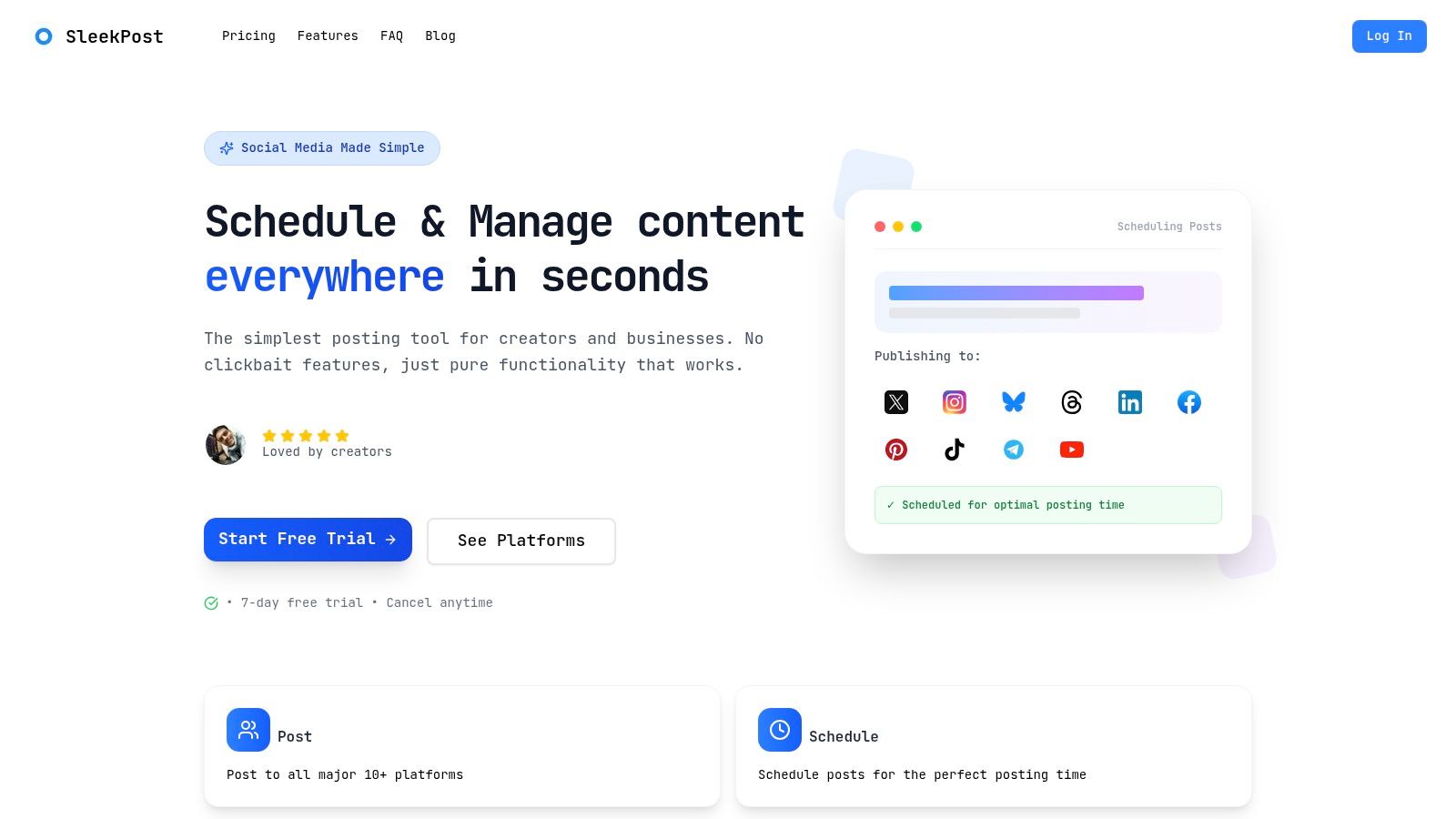
SleekPost is one practical option for this workflow. Its dashboard supports scheduling and publishing across 10+ social networks, with per-platform customization, recurring posts, queue-based scheduling, and support for carousels, videos, reels, and text updates. Its AI Content Generator can turn prompts or links into draft platform-specific posts, which is useful for creating a first pass before editorial review.
Automation should remove repetitive handling, not judgment. Don't schedule a generic post just because a slot is empty. Check whether the message still fits the audience's current questions and whether the next post gives people a reason to continue the sequence.
For the mechanics of queueing, recurring posts, and approval routines, use this practical guide on how to schedule social media posts.
The following video gives a visual product overview. Watch it after you've mapped your own workflow so you can judge which functions solve an actual bottleneck.
Review performance on a fixed cadence, not after every post. A single result can reflect timing, topic, distribution, or chance. Look for patterns across a group of related assets, then adjust the pillar, format, platform role, or call to action that appears to be limiting progress.
Community Tactics and Measuring Retention
Acquisition gives you attention. Community work gives people a reason to return.
A post can introduce your brand to a new viewer, but the follow-up experience determines whether that person becomes a regular participant. Reply to useful comments with substance, ask specific follow-up questions, host Q&A sessions around recurring problems, and make audience contributions visible in future content. A private group can deepen the relationship, but only if members receive a clear purpose and regular reason to participate.

Compare reach with relationship
Social acquisition is fast and broad. It helps you test ideas, find unfamiliar audiences, and create public proof that people care about a topic. Its weakness is dependence on distribution rules you don't control.
Community-led growth is slower and more labor-intensive. It produces richer feedback, stronger recognition, and more opportunities for members to help one another. Its weakness is that a community without moderation, programming, or a useful shared purpose becomes another abandoned channel.
Email sits between these models as an owned relationship. In the 2026 State of Audience in Media report, 67% of respondents identified email and newsletters as a top audience growth driver, while 68% said newsletters or digest products were their most effective retention tactic, according to Omeda's State of Audience 2026 report. The strategic lesson is straightforward: discovery works better when it leads to subscription and repeat exposure.
Use a simple retention scorecard:
- Repeat engagement: Are people commenting, replying, saving, or returning to later content?
- Subscriber activity: Do new subscribers remain active after the initial sign-up?
- Churn: Which audience segments stop opening, participating, or following?
- Referral behavior: Do members recommend the content or invite relevant peers?
- Conversion quality: Do returning people take the business action that matters?
The right metric depends on the relationship you want to build. A creator may prioritize repeat replies, while a B2B team may care more about returning visitors and qualified conversations. Don't compare community health with reach as if they measure the same thing.
For the practical distinction between attention and participation, this overview of what audience engagement means provides a useful vocabulary. Then create a recurring feedback loop: collect questions, answer the most useful ones publicly, expand the strongest answers into owned content, and invite the audience back into the discussion.
Retention is not what happens after growth. Retention is the part that makes growth compound.
Your 90-Day Implementation Timeline
A 90-day plan works because it limits simultaneous change. Don't launch five platforms, rebuild your brand, start a newsletter, and redesign the content process in the same week. Establish the measurement system first, then improve production and distribution, then strengthen the relationships that remain.
Days 1 to 30
Set the baseline and document the audience.
- Choose the primary metric: Select follower growth rate, social-attributed sessions, subscriptions, or another outcome tied to the business.
- Audit the last 90 days: Group posts by pillar, format, platform, reach, engagement quality, traffic, and conversion behavior.
- Write the ICP: Capture problems, motivations, objections, language, and information habits.
- Select the pillars: Choose three to five durable topics that your team can explain from multiple angles.
- Map the journey: Define the path from discovery to follow, subscription, repeat engagement, and business action.
Don't optimize yet. First make sure the data is labeled consistently and the team agrees on what success means.
Days 31 to 60
Build the operating rhythm.
Create one strong source asset, then produce platform-native derivatives from it. Test different hooks, formats, and calls to action while keeping the underlying topic clear enough for comparison. Schedule the approved work in advance, but leave capacity for conversations and timely responses.
At the end of this phase, identify which combinations are earning useful attention. A strong result isn't just the highest reach. It might be a smaller audience that saves content, visits the site, subscribes, or asks questions that reveal genuine buying intent.
Days 61 to 90
Invest in the signals that survived testing.
Increase production for the strongest pillar and platform combination. Remove formats that consume time without creating reach, engagement, traffic, or retention. Start or strengthen the newsletter and community touchpoints that give new followers a reason to stay connected.
Finish the cycle with a written decision log:
- Keep: What produced qualified attention or repeat activity?
- Change: What needs a new hook, format, platform role, or call to action?
- Stop: What created output without a meaningful audience response?
- Test next: What single assumption deserves investigation in the next cycle?
An audience growth strategy becomes durable when every cycle produces a decision. Set the baseline, create for a defined audience, distribute through a deliberate portfolio, and measure whether people return. That discipline will outperform a calendar built around random posting and hope.
SleekPost gives creators and small teams one dashboard for scheduling, adapting, and publishing content across multiple social platforms, with recurring queues and AI-assisted draft creation. Visit SleekPost to see whether it can simplify your distribution workflow and keep your audience growth system moving.