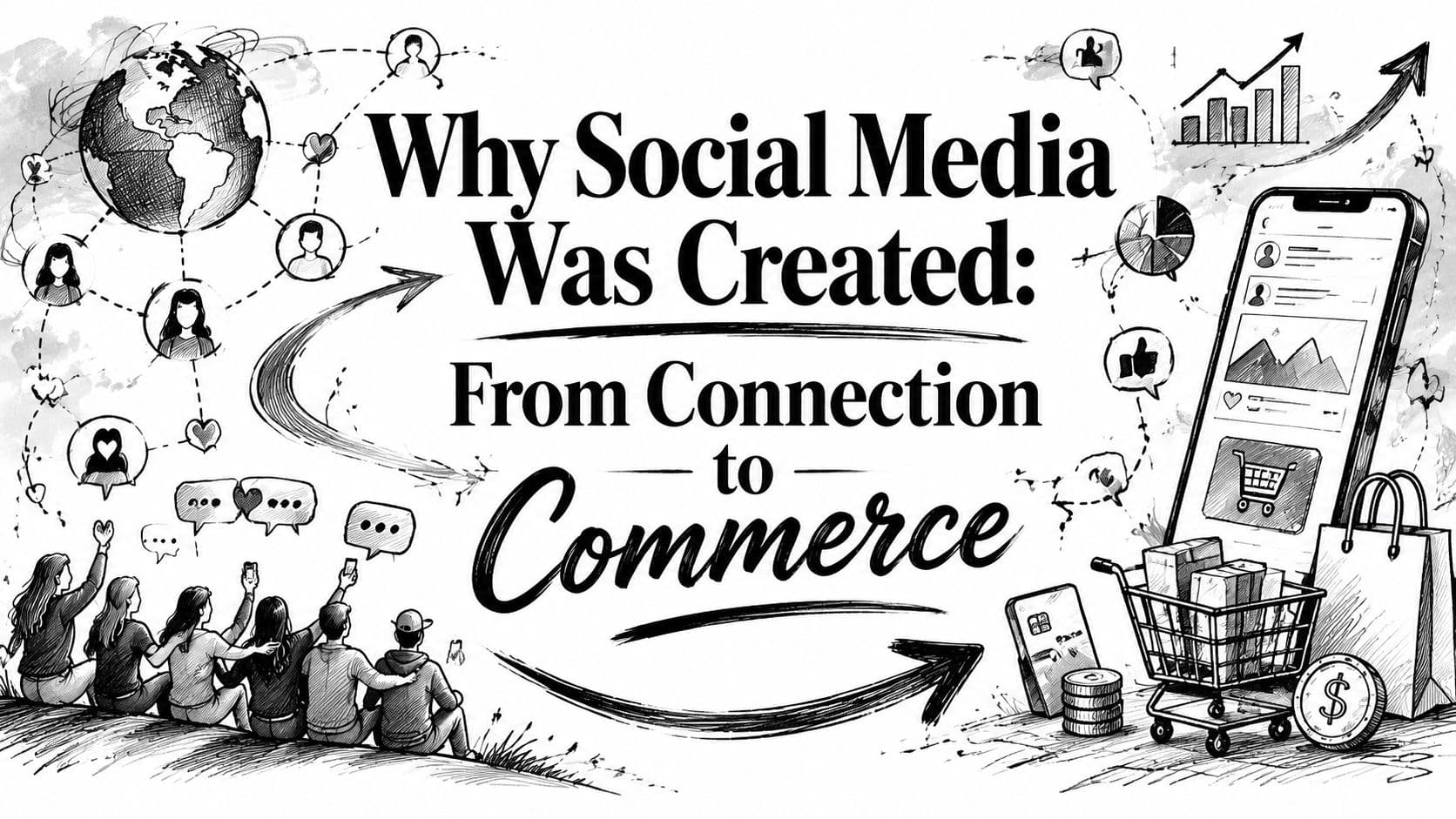
It's widely believed that social media's purpose is already understood. The usual answer is simple: to help people connect online.
That answer is incomplete.
If you want to understand modern platforms, and why posting can feel like talking to friends one day and performing for a machine the next, you need a better model. Social media wasn't built for just one purpose. It grew from two intertwined needs: community-building and distribution. One is the digital campfire. The other is the broadcast system.
That distinction matters more now than ever. If you look at how platforms behave, how creators grow, and how brands win attention, you can see that the old “it's just for connection” story doesn't explain enough. It also doesn't help you build a strategy that fits the way platforms work today. If you want to keep up with broader platform shifts, this overview of digital marketing trends is a useful companion.
Table of Contents
- The Question You Think You Know the Answer To
- The Original Blueprint Building Digital Campfires
- The Great Pivot When Attention Became the Product
- Four Key Impacts on Modern Life
- What This Origin Story Means for Your Strategy
- Conclusion Your Role in Social Media's Next Chapter
The Question You Think You Know the Answer To
Ask someone why social media was created and they'll usually say the same thing: “so people could connect online.” That's true, but only in the way a map is true. It gives you the outline, not the terrain.
The story gets more interesting when you separate social networking from social media. Britannica makes that distinction by treating networking as community-building and social media as a broader system for building and reaching an audience through shared content and participation, as discussed in Britannica's overview of social media. That difference explains a lot of modern confusion.
Connection and distribution are not the same job
A group chat connects people. A public feed distributes content.
A private forum builds belonging. A recommendation engine expands reach.
Those functions can overlap, but they don't produce the same behavior. If you treat them as the same thing, modern platforms become hard to read. You'll wonder why a network that began with friends and communities now seems obsessed with views, watch time, discoverability, and constant posting.
Core idea: Social media grew by serving two human desires at once. We want to belong somewhere, and we want to be seen.
That's the strategic clue many creators miss. They build only for closeness and wonder why growth stalls. Or they build only for reach and wonder why the audience feels thin, unstable, or indifferent.
Why the old explanation falls short
The phrase why social media was created matters because it points to platform design, not just history. Early tools solved a communication problem. Later platforms expanded that solution into something bigger: a system for visibility at scale.
That scale changed the meaning of the product itself. Once social media reached more than two-thirds of internet users globally, the original purpose didn't disappear. It got absorbed into a much larger media and attention ecosystem, as noted in the Britannica reference above.
If you're a creator or business owner, that means you're not just participating in a digital social space. You're operating inside a hybrid environment where conversation and distribution happen side by side. That's why your strategy has to account for both.
The Original Blueprint Building Digital Campfires
Before feeds became addictive and before creators built businesses from short videos, there was a simpler problem to solve. People could send emails and make phone calls, but those were mostly one-to-one tools. They didn't give groups a shared place to gather, express identity, and keep relationships visible over time.
Social media emerged to solve that gap.

From private messages to shared spaces
The earliest web communities hinted at the idea. People wanted more than isolated communication. They wanted a shared environment where conversation could stay alive, where identity could be persistent, and where relationships could be visible.
That's what made early social platforms feel new. They didn't just let you send a message. They let you exist in public online in a recognizable way.
Three design choices made that possible:
- Profiles created identity: Instead of being just an email address or screen name, a person could build a recognizable digital self.
- Connections mapped relationships: Friend lists and networks turned the web into a visible social graph.
- Shared posting created presence: Status updates, comments, and media let people participate in an ongoing group conversation.
This is why the campfire metaphor works. A campfire isn't only about speaking. It's about gathering, signaling presence, and returning to the same place over time.
For creators planning community-first content, a practical system matters. A content planning tool can help you organize recurring themes, audience questions, and conversation prompts before posting turns reactive.
The profile changed everything
One of the least appreciated shifts in internet history was the move from pages to people. Early websites were often static. Social platforms made the individual account the center of the experience.
That changed behavior in a big way. Once users could create profiles, connect to others, and share within a visible network, the web felt less like a library and more like a social environment.
A key milestone came when MySpace became the first social media site to reach 1 million monthly active users around 2004, a moment often treated as the point when social media began to look like a mass medium, according to Maryville University's history of social media. That wasn't just a growth milestone. It signaled that networked self-expression had escaped niche internet culture.
Social media began as a way to scale human presence, not just human messaging.
The long-term adoption curve confirms that the need was real. The same Maryville source notes that U.S. adult social media use rose from 5% in 2005 to 79% in 2019. In plain terms, the campfire got bigger. Much bigger.
What early platforms were really offering
People often describe those first platforms as “places to connect with friends,” but that still understates it. They offered a new social architecture:
| Function | What it changed |
|---|---|
| Persistent identity | You could return to the same digital self instead of starting from scratch every interaction. |
| Visible networks | Relationships became structured and searchable. |
| Ambient sharing | You didn't need a direct message every time. Others could keep up with you passively. |
That last point matters. Social media wasn't just better email. It was the start of many-to-many communication, where one post could speak to a whole network at once.
That's the original blueprint. A place to gather, share, and belong.
The Great Pivot When Attention Became the Product
The campfire model made social media useful. It didn't automatically make it profitable.
As platforms expanded, they needed a business model that could support huge volumes of user activity. That pressure changed the product. The network was no longer just a host for relationships. It became an engine for capturing, organizing, and selling attention.

Web 2.0 turned users into publishers
A major technical shift made this possible. Social media platforms are Internet-based applications built on Web 2.0 foundations that let users create and share content, according to the peer-reviewed overview in PMC. That sounds academic, but the practical meaning is simple: users stopped being passive readers and became active publishers.
Every post, comment, upload, reaction, and share created more inventory for the platform. More content meant more reasons to return. More returning meant more opportunities to show ads, recommend accounts, and shape behavior through ranking systems.
The creators and businesses that understand this don't treat posting as random self-expression. They treat it as participation in a distribution system. That's one reason marketers keep looking at categories like top social lead generation tools 2026. They're trying to connect audience attention to measurable business outcomes.
Later in your workflow, measurement matters as much as publishing. A social media ROI calculator can help translate activity into something closer to business value.
The feed stopped being neutral
At first, many people experienced social media as a stream of updates from people they knew. Over time, that changed. Platforms increasingly relied on algorithms to decide what content, ads, and connections users see, with an architecture designed to maximize participation and rapid diffusion, based on the same PMC reference.
That's the pivot.
The feed stopped being a simple mirror of your network and became a ranked environment. The platform began deciding what should surface, what should spread, and what should disappear.
Many creators often get frustrated. They think they're posting into a community space. In reality, they're often publishing into a competitive recommendation system.
A few consequences follow:
- Engagement became a signal: Likes, comments, shares, saves, and watch behavior started influencing distribution.
- Content design changed: Hooks, pacing, format, and retention started mattering more because the algorithm needed behavioral feedback.
- Users became inventory: Attention itself became the thing being packaged and sold.
Practical rule: Don't confuse a platform's branding with its mechanics. It may talk like a community product while operating like a distribution marketplace.
That doesn't make social media fake. It means its incentives expanded. The same systems that can help a creator reach strangers can also pull users toward content that keeps them active longer. Connection still exists, but it now competes with optimization.
Four Key Impacts on Modern Life
Once social media became both a social layer and a distribution layer, its effects spread far beyond personal communication. It started shaping friendship, news, commerce, learning, identity, and public conversation.
That complexity is easier to understand if you split the impact into four areas instead of asking whether social media is “good” or “bad.”

Connection without geography
The most obvious benefit is still real. Social media made it easier to maintain relationships across distance, time zones, and life stages. Friends who would've drifted apart could keep a weak tie alive through updates, messages, and shared media.
That matters for everyday life, but it also matters for creators. An audience no longer has to live near you, know you personally, or discover you through traditional media. Social platforms lowered the friction of finding people with shared interests.
This is one reason social media often feels more intimate than older forms of broadcasting. You can publish to a broad audience while still sounding personal.
Communities became more searchable and more scalable
Early online communities existed before modern social media, but platforms made them easier to discover and participate in. That changed the social function of the internet.
A niche hobbyist, a local organizer, a freelance designer, or a patient looking for peer support could all find others faster than before. The result wasn't just more conversation. It was more visible micro-communities.
Some of those communities are small and deep. Others become movements, fandoms, or professional ecosystems.
A few examples of what this changes:
- Learning gets faster: People can watch workflows, ask questions, and learn from practitioners in public.
- Identity gets reinforced: Users can find language, norms, and peers that help them feel less isolated.
- Trends travel quickly: Ideas move from one niche to another with very little friction.
Small communities often create the strongest trust. Large reach usually comes later.
Social became a commercial main street
The original purpose expanded dramatically. By 2023, there were around 5 billion social media users worldwide, and the United States spent 72.3 billion US dollars on social media advertising that year, according to Wikipedia's social media overview. That tells you social platforms are no longer just places to socialize. They are a major commercial channel.
Businesses use them to attract attention, explain products, answer questions, and move people toward purchase. For creators, this means content can serve multiple roles at once: audience growth, trust-building, education, and conversion.
That's also why format matters. If you're trying to communicate clearly in crowded feeds, resources like Wideo's tips for social media marketing can help you think through how video content holds attention and delivers information more effectively.
If your work depends on platform-level performance, native data matters too. Learning how to get insights from Instagram can help you spot what's resonating instead of guessing from surface reactions.
The tradeoff is algorithmic pressure
The same systems that make discovery easier also create tension.
When platforms optimize for participation and spread, they influence what kinds of content people make and what kinds of content users keep seeing. That can narrow perspective, reward emotional intensity, and push creators toward formats that perform rather than formats that always serve their audience well.
Here's a compact view of the tradeoff:
| Benefit | Pressure it creates |
|---|---|
| Easy discovery | More competition for attention |
| Community at scale | Harder to maintain depth and trust |
| Fast distribution | Incentive to simplify or sensationalize |
| Commercial opportunity | Constant performance measurement |
This is why social media can feel strengthening and exhausting at the same time. It opens doors. It also keeps score.
What This Origin Story Means for Your Strategy
If you understand why social media was created, your strategy changes immediately. You stop treating platforms as one thing.
They are two things at once. They are a broadcast system and a community environment.
Most weak strategies fail because they overcommit to one side.

Use the broadcast tower on purpose
Broadcast content helps strangers find you. It's designed for reach, discovery, and clarity.
This is the side of social media that works with the algorithm instead of pretending it isn't there. Short videos, visual explainers, strong hooks, searchable captions, opinion-led posts, and repeatable content formats all belong here.
Use this mode when you need to:
- Attract new people: Make content a stranger can understand without prior context.
- Signal expertise fast: Teach one clear idea, solve one visible problem, or frame one sharp perspective.
- Create consistency: Publishing regularly gives platforms more chances to understand where your content fits.
This is also the operational side of social media, where scheduling and distribution systems become useful. A tool like SleekPost helps teams schedule and publish across multiple platforms from one dashboard, which is practical when you're adapting content for different channels. Broader planning principles show up clearly in a content distribution strategy, especially when you want one idea to travel without becoming repetitive.
If you're producing ads or performance-focused creative at scale, tools for ShortGenius automated ad generation can also be relevant because they support rapid asset creation for distribution-heavy campaigns.
Build the cozy campfire deliberately
Reach gets attention. Community keeps it.
The campfire side of strategy is where followers become participants. Here, replies, DMs, comments, recurring themes, audience rituals, and recognizable voice start doing the work.
You build this side differently. The goal isn't maximum spread. The goal is trust and return behavior.
A strong campfire usually includes:
Predictable value
People know what kind of help, perspective, or experience they'll get from you.Visible listening
You answer questions, reference audience feedback, and show that the relationship isn't one-way.Room for participation
Prompts, polls, Q and As, response videos, and comment-led posts make the audience part of the content loop.
If people only consume your posts, you have reach. If they start replying, returning, and recognizing one another, you have community.
The winning model is hybrid
You don't have to choose between growth and depth. The strongest social strategies use one to feed the other.
Broadcast content attracts new people. Campfire content gives them a reason to stay.
That can look like this:
- A short educational video reaches new viewers.
- The caption or comments invite a more specific conversation.
- A follow-up post answers questions from that discussion.
- A newsletter, group, DM sequence, or recurring series deepens the relationship.
The practical lesson is simple. Don't build only for virality, and don't post only for the people who already know you. Use public-facing content to open the door, then create smaller moments of trust inside that larger system.
That's the clearest modern answer to why social media was created. It was built to connect people, then evolved to distribute attention. Your strategy should respect both realities.
Conclusion Your Role in Social Media's Next Chapter
The simplest version of the story is that social media was created to help people connect online. The more useful version is that it created a new kind of digital space where people could gather, express identity, share publicly, and eventually build audiences at scale.
That shift explains almost everything creators wrestle with now. Why some posts feel relational and others feel performative. Why community matters, but reach still drives growth. Why platforms reward consistency, clarity, and interaction, even when those goals don't always align perfectly.
If you understand that tension, you make better decisions.
You stop asking only, “How do I get more views?” and start asking, “What is this post for?” Is it meant to attract strangers, strengthen trust, start a conversation, or move someone closer to action? That question leads to better content than chasing trends blindly.
The people who do well on social media aren't always the loudest. They're often the ones who understand what the platform is asking for, and what their audience needs from them.
That's your advantage now. You know the system has two hearts: the broadcast tower and the campfire. Use the first to get discovered. Use the second to become memorable.
If you want a simpler way to run the broadcast side without losing time to manual posting, SleekPost gives creators, marketers, and small teams a clean way to schedule, adapt, and publish content across multiple social platforms from one place.