You post every day. You use sounds that are already moving. You add hashtags, answer comments, and wait for the graph to lift. Instead, every upload stalls around the same low view count, and you start searching why am I not getting views on TikTok while wondering whether TikTok has buried your account.
That conclusion is usually too simple. Low views can come from weak viewer response, poor audience fit, or limited recommendation eligibility. Those problems look similar on the surface, but they require completely different fixes. Rewriting a caption won't repair a weak opening, and a sharper hook won't solve a video that isn't eligible for broad For You distribution.
The useful question isn't whether TikTok is “against” your account. It's which part of the distribution process failed. TikTok says follower count and a history of previous high-performing videos aren't direct ranking factors, so a small account can reach new viewers, while an established account can still produce a low-performing upload. (TikTok explains how it recommends content)
Table of Contents
- The Moment Every Creator Hits Zero
- How the TikTok Algorithm Decides Who Sees Your Video
- The Seven Most Common Reasons Your Views Stay Low
- The Hidden Reason Most Videos Get Buried
- Prioritized Fixes You Can Apply This Week
- How to Read Your TikTok Analytics Like a Diagnostic Tool
- The Untapped Channel Most Creators Overlook
- Your 14-Day TikTok Reach Recovery Plan
The Moment Every Creator Hits Zero
Maya followed a routine that looked sensible. She filmed after work, edited on her phone, posted daily, and rotated through popular sounds. Her account had followers, yet each new video stalled near the same low view count. She changed captions, added hashtags, tested posting times, and finally decided TikTok had shadowbanned her.
She had not found the cause. She had skipped the diagnosis.
Low views usually point to one of two failures: retention or distribution eligibility. A video may reach an initial audience and lose viewers immediately. Another may be watchable but shown to too few people because its recommendation eligibility is limited. A third may hold attention while targeting an audience with little reason to care. The view count looks identical in all three cases.
The view count is a symptom, not a diagnosis.
Use a simple triage sequence before rewriting captions. First, check account and post notifications if For You traffic has suddenly disappeared across affected videos. Next, inspect early retention and average watch time. Immediate exits point to the opening or structure. Healthy retention with unusually narrow reach points toward eligibility or audience fit.
TikTok states that follower count and a history of viral posts do not directly determine For You ranking. (TikTok's recommendation documentation) Followers cannot guarantee views, and a stalled account is not automatically doomed.
For your next upload, record three answers: what the first viewers did, where traffic came from, and whether the post was eligible for broad recommendation. Those answers identify the failure before you spend a week changing hashtags.
How the TikTok Algorithm Decides Who Sees Your Video
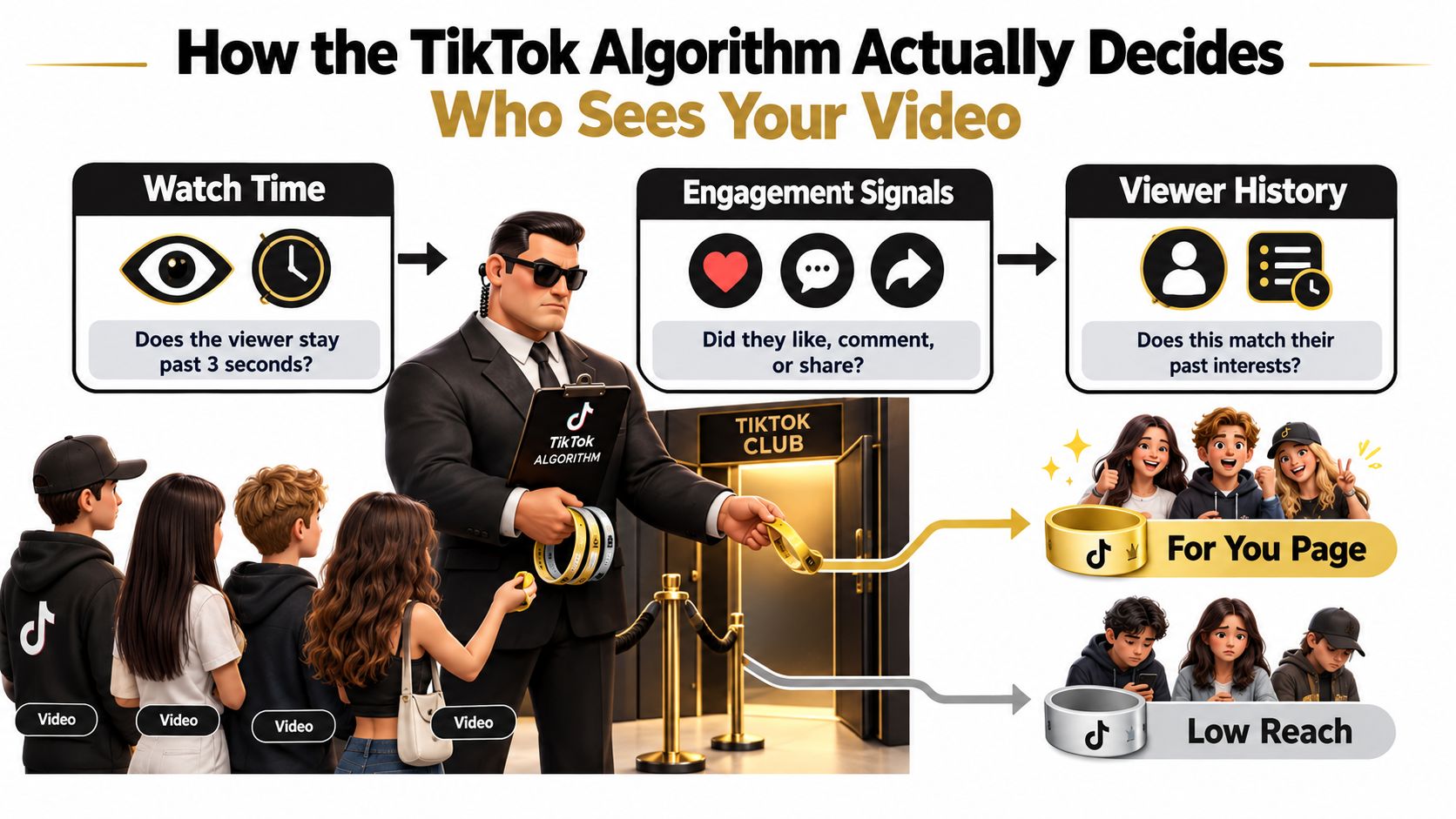
TikTok's For You feed ranks videos by relevance rather than treating followers as a guaranteed audience. The system observes how viewers respond, then tests whether the video fits people with similar interests.
TikTok evaluates several signal groups:
- User interactions: Watch behavior, likes, shares, comments, follows, and skips.
- Video information: Captions, sounds, and hashtags.
- Viewer context: Language, country, device type, and account settings.
Watch behavior usually provides stronger evidence than broad device, language, location, or country settings. A completed video signals sustained interest, while an immediate skip suggests a weak match. As noted earlier, this is why a follower count cannot explain every stalled upload.
What the first audience tells TikTok
Your opening must make the viewing payoff clear. A viewer who understands the promise and continues watching gives TikTok stronger evidence than someone who only sees your username or follows your account.
Use the first audience as a diagnostic sample. If viewers leave immediately, investigate the opening, pacing, or promise. If they watch but the video reaches very few people, check eligibility, audience fit, and account or post notices before rewriting hashtags.
Posting time can affect early availability, but it cannot rescue irrelevant content. A popular sound may help classify a topic, yet it cannot make a confusing video worth finishing. Review short-form video trend research for format and audience patterns, then test those patterns against your own topic instead of copying trends blindly.
For a commerce-focused application of recommendation signals, compare this framework with HiveHQ's guide to TikTok Shop growth in 2025. The practical rule is straightforward: state the topic quickly, deliver the promised value, and make the ending earn the watch time.
A trend can provide context. Viewer response determines whether distribution expands.
The Seven Most Common Reasons Your Views Stay Low
Most stalled accounts aren't failing because of one mysterious setting. They repeat a small set of detectable mistakes.
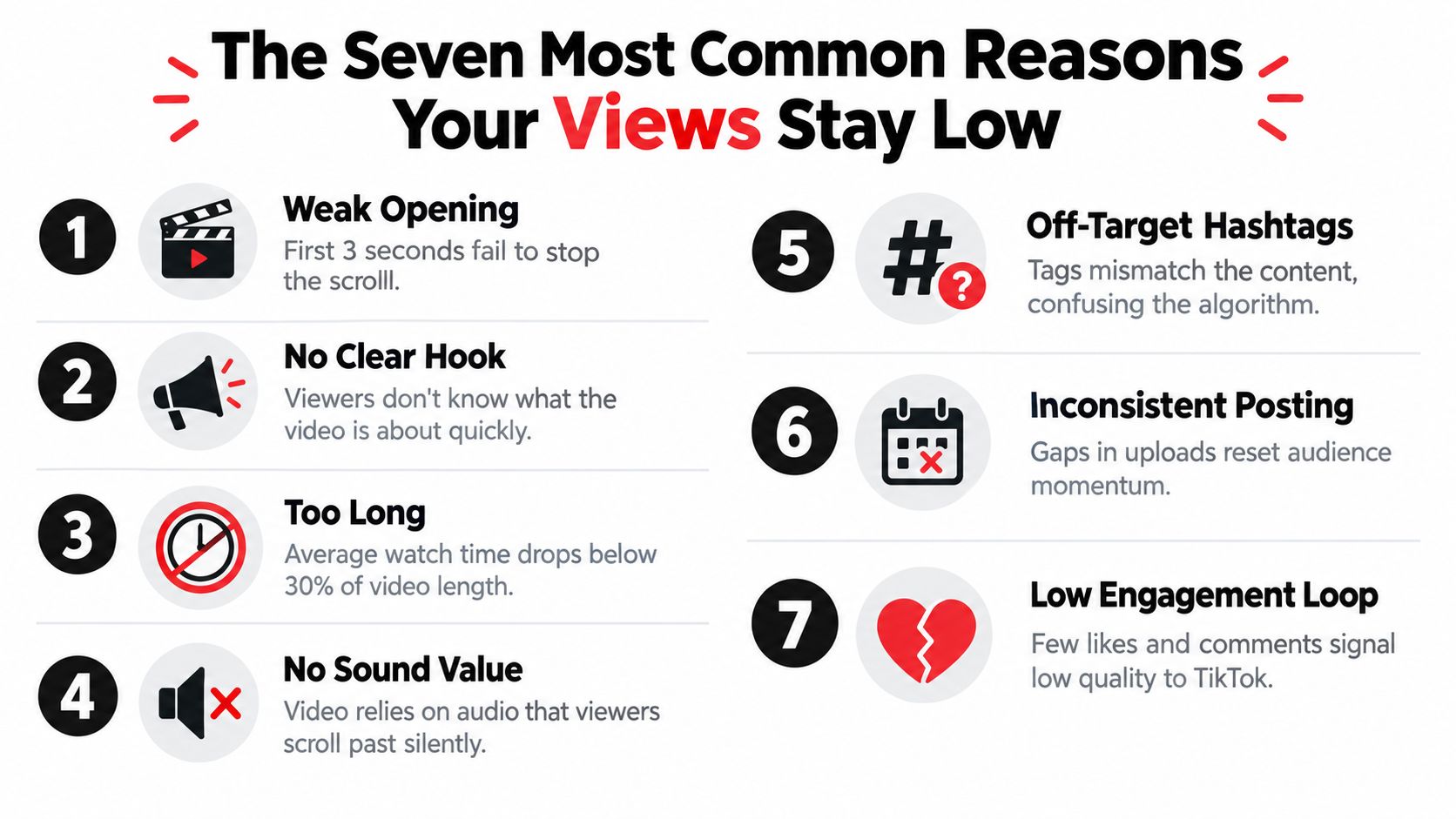
- Weak opening: The first moments show a logo, greeting, or setup instead of the subject. Look for a sharp early drop in the retention curve.
- Unclear promise: Viewers can't tell what they'll learn, see, or feel. If the opening needs a second explanation, the video is already asking too much.
- Poor length fit: The video takes longer than the idea deserves, or it ends before the viewer understands the value. Compare average watch time with the video's total length, not with an arbitrary ideal.
- Weak audio or visual delivery: Muffled sound, dark footage, tiny text, or broken captions create friction. A good idea can't compensate for a video people struggle to consume.
- Misleading context: Captions, hashtags, and sounds describe one subject while the video delivers another. This can attract the wrong initial viewers, creating rapid skips.
- Niche drift: An account trained around practical tutorials suddenly publishes unrelated personal clips, promotional posts, or broad commentary. Existing viewers may ignore the shift, while new viewers have no reason to engage.
- Reused or borderline material: Recycled clips, visible platform branding, graphic demonstrations, regulated products, or engagement-bait language can create an eligibility concern. Check notifications and post analytics before assuming the creative itself failed.
Match the symptom to the likely cause
A weak hook usually produces an immediate retention collapse. A niche problem often produces acceptable early retention but limited follows, shares, or repeat interest from the intended audience. An eligibility problem looks different again, with an abrupt change in For You traffic or a notification attached to the account or post.
Don't rewrite every element at once. Pick the signal that changed, then test one meaningful variable. The three second hook framework is useful for tightening the opening, but you still need to verify whether early retention is where the video breaks.
Use TikTok content ideas for new tests only after you know what you're testing. A new topic won't teach you much if the key problem is poor audio or an ineligible post.
The Hidden Reason Most Videos Get Buried
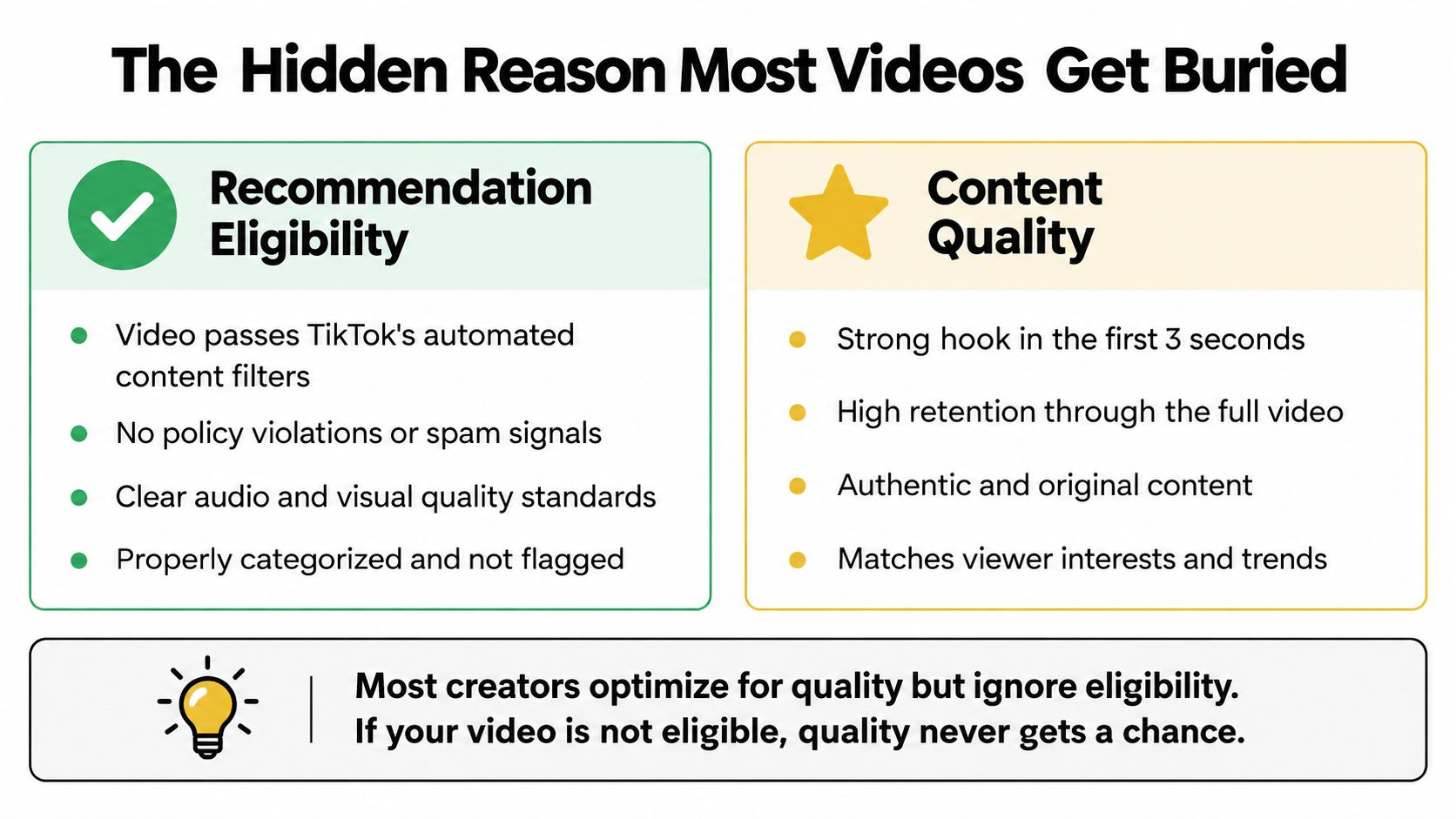
A creator can spend an hour tightening the opening, then discover the video never received a normal chance to compete. That is the hidden split behind low TikTok views: a retention problem keeps viewers from watching, while an eligibility problem limits who can receive the post.
TikTok separates content allowed on the platform from content eligible for broad For You distribution. A video can remain available while receiving limited recommendation because it is under review, newly uploaded, potentially unsuitable for a general audience, or linked to repeated policy issues. Read TikTok's guidance on recommendation eligibility before treating every low-view result as a weak hook.
Run the eligibility check before rewriting the video
Inspect account and post notifications. Compare the affected upload's For You traffic with a normally distributed post from the same account. Review content near policy boundaries, including regulated products, graphic demonstrations, reused clips, and language designed to manufacture comments or follows.
Use the comparison to isolate the failure. If several normal posts retain healthy For You traffic but one video shows a sudden restriction signal, treat it as a distribution issue. If posts receive exposure but viewers leave quickly, treat it as a performance issue.
A stronger hook can't open a distribution gate.
Creators waste time by shortening edits, changing hashtags, and filming new intros while eligibility remains the constraint. TikTok considers content information and interaction signals, but those signals can only help after the post has a suitable path into recommendation.
If a warning appears, follow the available review or appeal process and remove the questionable element from the next test. Do not publish near-identical borderline posts and expect retention to override a restriction. For a broader framework covering publishing workflows and reach, use this content distribution strategy.
Prioritized Fixes You Can Apply This Week
Run one controlled test at a time. If you change the hook, caption, sound, topic, length, and posting time together, you create activity without learning what caused the result.
Today
Make the next video clear without sound. Put the audience and payoff on screen immediately, remove greetings and logos, improve the audio, and cut visual clutter. Make the ending fulfill the opening promise. If you promise three solutions, deliver three solutions instead of switching to a sales pitch.
Keep the test simple: preserve the topic and format, then change one performance variable.
This week
Check the retention curve and identify the first major drop. Rewrite that moment, then create a shorter edit and another version with clearer on-screen keywords. Keep the subject and core idea similar enough for a useful comparison.
Review recent uploads for eligibility concerns. Check account and post notifications, compare For You traffic, and stop reusing any sound, clip, or framing that repeatedly appears in affected posts. More hashtags will not repair a distribution problem.
This month
Choose a clear subject lane and stay with it long enough to build audience expectations. If your schedule produces rushed videos, publish fewer, stronger tests. Replace generic tags with accurate context, and use sounds only when they fit the subject and audience.
| Tier | Time to apply | Action | Diagnostic signal it fixes |
|---|---|---|---|
| Immediate | Next upload | State the promise early, remove delays, improve audio and captions | Rapid opening drop |
| Weekly | Several tests | Compare a shorter edit, revised hook, and clearer keywords | Weak watch time or completion |
| Account review | Same week | Check notices, For You traffic, and borderline elements | Sudden distribution decline |
| Strategic | Coming weeks | Narrow the niche and build a consistent topic pattern | Low follows, shares, or audience fit |
Use two diagnoses to choose the next move. Viewers leaving early points to the opening, pacing, or payoff. Strong retention paired with sharply reduced For You exposure points to eligibility or distribution. A better hook cannot fix a restricted path to recommendation.
TikTok says new videos often receive an engagement peak soon after publication, while performance can continue developing over several days. (TikTok's newsroom explanation of recommendations) Do not judge a post from an immediate snapshot, but do not use delayed performance to excuse a clear retention collapse.
How to Read Your TikTok Analytics Like a Diagnostic Tool
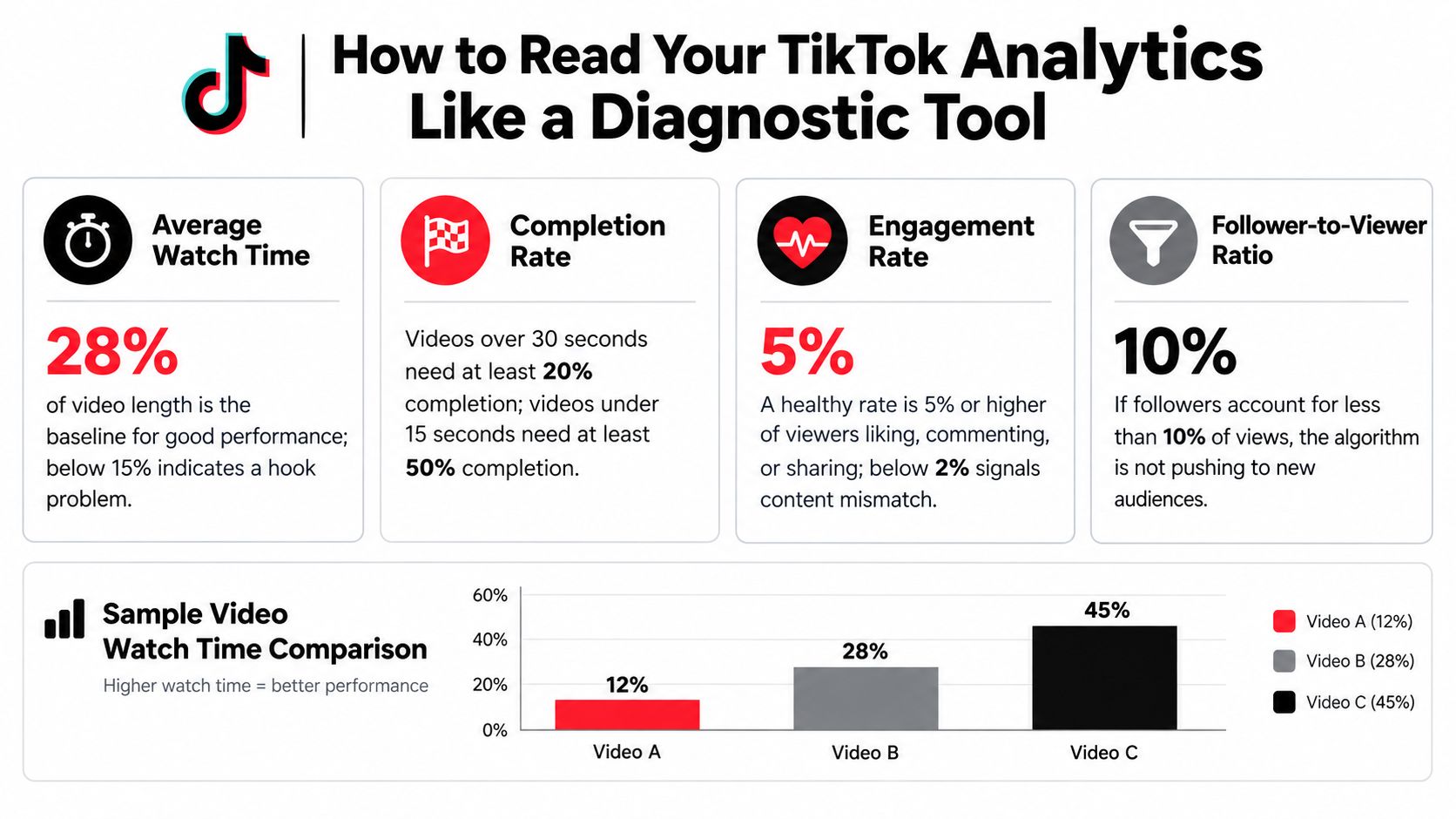
Open TikTok Studio and compare a low-view post with a stronger post from the same account. Keep the topic and format similar so one changed variable stands out. The goal is diagnosis, not a universal benchmark.
Read the pattern, not one number
- Early retention falls sharply: The opening fails to communicate value or creates confusion. Replace the first visual and sentence.
- Average watch time is weak for the video length: The pacing, structure, or payoff loses attention. Cut setup and move the useful detail forward.
- Completion is strong but views remain narrow: Check eligibility, For You traffic, and audience fit before rewriting the script.
- Shares and follows are meaningful but likes are modest: The video may solve a specific problem well. Keep the topic and improve its packaging.
- For You traffic drops abruptly: Compare the post with normally distributed uploads and check account notifications. Treat this as a distribution review.
Watch time and completion help indicate viewer interest, while performance may continue developing after publication. Use those signals with traffic source data rather than judging a post from one early snapshot.
Use analytics to choose the next edit
If viewers leave before the subject becomes clear, fix the opening. If they stay through the explanation but leave before the ending, shorten the route to the payoff. If retention remains healthy while discovery falls, stop treating the problem as a script failure. You may be dealing with eligibility or distribution instead.
Traffic sources separate these diagnoses. Limited For You traffic with solid search or profile traffic suggests a different opportunity from a post that receives little attention anywhere. Record source mix, retention, shares, and follows for every test. Then change one major input, such as the opening, length, or topic framing.
Keep a simple record of each test and its outcome. SleekPost's reporting best practices can help structure recurring reports and make comparisons easier.
The Untapped Channel Most Creators Overlook
Creators often optimize for the For You feed and ignore search intent. That leaves useful, specific questions unanswered while everyone else competes for the same broad trend.
Reporting on TikTok's Creator Search Insights says nearly 40% of users search on TikTok several times per day, and 73% search at least once daily. The same reporting says TikTok search activity exceeded other major platforms in that analysis. (Search Engine Land's coverage of Creator Search Insights)
Search views change the way you choose topics. A tutorial answering a precise question can continue attracting relevant viewers after a trend has faded. This is especially useful for local services, product explainers, practical tutorials, and niche business content.
Build one video around one query
Start with a specific phrase someone would type, not a broad category. Then follow this sequence:
- Name the question early: Say the query naturally in the opening sentence.
- Show the wording: Put the same idea in on-screen text and the caption without forcing it.
- Answer before expanding: Give the direct solution early, then demonstrate or explain it.
- Create a visible result: Show the finished outcome, comparison, process, or mistake.
- Separate traffic sources: Review search-driven views and For You views independently in analytics.
Keywords can help TikTok understand the subject, but they don't replace satisfaction. The platform still uses watch behavior, skips, likes, comments, and shares to judge whether the video deserves broader recommendation. Search makes the video discoverable for a question. Retention gives it room to travel.
Avoid stuffing captions with unrelated trends. A precise query paired with a clear demonstration gives TikTok better context and gives viewers a reason to stay.
Your 14-Day TikTok Reach Recovery Plan
Use the next two weeks as a controlled investigation, not a frantic posting sprint. Save the links, analytics, and notes for every test so you can identify patterns instead of relying on memory.
Days one and two
Review recent uploads and label each one as a hook, retention, niche, or distribution problem. Check the first retention drop, traffic sources, shares, follows, and any account or post notification. Don't edit a new video until you've made that classification.
Days three through five
Publish three videos around one clear topic. Keep the subject stable while changing the opening or structure. Include one previously underused question that has obvious search intent, and make the answer visible immediately.
Days six through ten
Follow the strongest diagnostic signal. If early retention is the repeated failure, tighten openings and remove setup. If distribution is the concern, audit borderline elements and review notifications. If niche fit is weak, stop jumping between unrelated subjects.
Use fewer variables in each test. Changing topic, sound, duration, caption, and hook at once means you won't know which change mattered.
Days eleven through fourteen
Compare the new group with the earlier posts. Look at retention, completion, shares, follows, search traffic, and For You traffic together. If the new posts hold attention but remain restricted, continue the eligibility investigation. If they receive normal discovery but lose viewers early, keep working on the creative.
Batching can make this process easier without turning your account into a content dump. A practical content batching workflow lets you prepare related tests while preserving a deliberate publishing sequence.
Don't promise yourself a viral recovery. Promise yourself a clean diagnosis. When the diagnosis is right, your next posts give you useful evidence instead of another round of guesses.
SleekPost lets creators plan and publish TikTok content from one dashboard, while its analytics and reporting tools help you compare posts without manually assembling every result. Visit SleekPost to organize your testing workflow and keep your publishing process consistent.